


This is a developing story. Trump now has the legal authority to impose this tariff, but has not yet decided whether to invoke it.
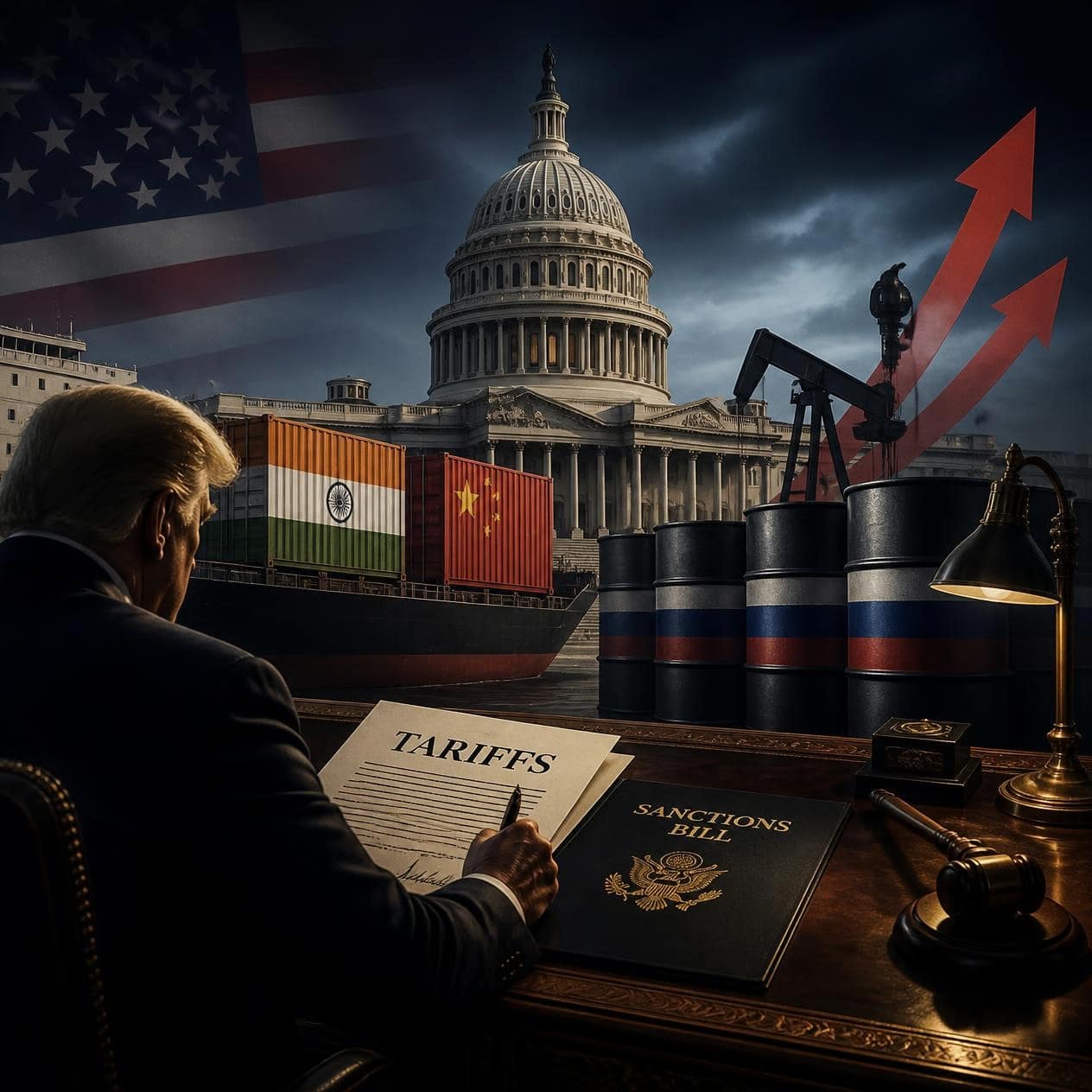
On September 17, 2026, the U.S. House of Representatives passed the “Lindsey O. Graham Sanctioning Russia and Iran Act of 2026” by a 262-159 vote, sending it to President Trump’s desk after the Senate had already cleared it by an overwhelming 86-11 margin in August. The bill — named after the late Senator Lindsey Graham, who died in July — gives Trump discretionary authority to impose tariffs of up to 100% on the top five importers of Russian oil and natural gas. It does not automatically trigger the tariff; that decision rests entirely with the president.
Who’s in the crosshairs
China and India are, by far, the largest buyers of Russian crude. According to the Centre for Research on Energy and Clean Air (CREA), China purchased roughly half of Russia’s crude exports as of late August 2026, while India accounted for about 37%. Turkey and the EU each take around 5%.
The BRICS backdrop
This tariff threat lands just days after India hosted the 18th BRICS Summit (September 12-13) in New Delhi — its fourth time chairing the bloc. Iranian President Masoud Pezeshkian made his first-ever visit to India for the summit, alongside Vladimir Putin and Xi Jinping. Iran and the UAE have been full BRICS members since 2024, and West Asia’s escalating conflict was among the summit’s central discussion points, alongside the New Delhi Declaration on global governance reform.
Washington’s stated rationale
The Trump administration’s core argument is that discounted Russian oil purchases by India and China are effectively bankrolling Moscow’s war in Ukraine. The legislation also targets Russia’s energy and defense sectors, President Putin and senior officials directly, and the so-called “shadow fleet” of tankers used to evade existing sanctions.
China’s pushback — and the contradiction critics are pointing to
China’s foreign ministry spokesperson Guo Jiakun rejected the bill outright, calling it “long-arm jurisdiction” with no basis in international law or UN Security Council authorization, and said Beijing’s energy trade is conducted on the basis of equality and mutual benefit — not something to be dictated by a third party. Analysts at Eurasia Group expect Beijing to simply continue its Russian imports regardless, treating energy security as non-negotiable.
But there’s a harder question underneath the diplomatic sparring: the U.S. itself, alongside Israel, has been engaged in a military campaign against Iran since strikes began in late February 2026 — including repeated bombing of Kharg Island, which handles roughly 90% of Iran’s oil exports. That conflict has repeatedly disrupted shipping through the Strait of Hormuz, the chokepoint for roughly 20% of the world’s crude oil supply. Saudi Arabia’s East-West pipeline — a key alternative route — has also been shut, narrowing the Middle East’s spare capacity further. India’s own crude basket price hit $126.88 a barrel on September 16, having crossed $100 the week before, a direct consequence of the supply disruption this war has caused. In other words, the same war Washington is fighting is a major reason the alternatives to Russian oil have gotten more expensive and harder to secure.
India’s position
India’s Ministry of External Affairs responded firmly on September 18: it “remains firmly committed to ensuring energy security for its 1.4 billion people” and will continue buying through “diversified sourcing” based on “evolving market dynamics.” Petroleum Minister Hardeep Puri has previously noted India has already expanded purchases from the U.S., West Africa, and Latin America — but Russia still supplies roughly 40% of India’s crude, partly because it remains priced near the $60/barrel G7 cap, well below prevailing international rates.
Who actually pays the price
China’s economy and political system are structurally very different from India’s, and Beijing’s options for absorbing a trade shock aren’t directly comparable to New Delhi’s. But regardless of that difference, tariff escalation and oil-price spikes both eventually filter down to fuel prices, transport costs, and inflation at the household level. As two of the world’s largest powers pursue their geopolitical objectives — Washington through tariffs and a war in West Asia, and Russia through a war in Ukraine — it is, once again, the ordinary citizen who absorbs the cost of decisions made far above their control.
(This article combines verified reporting with analysis and interpretation. Given the fast-moving nature of this story, details may change as Trump decides whether to formally invoke the tariff.)