


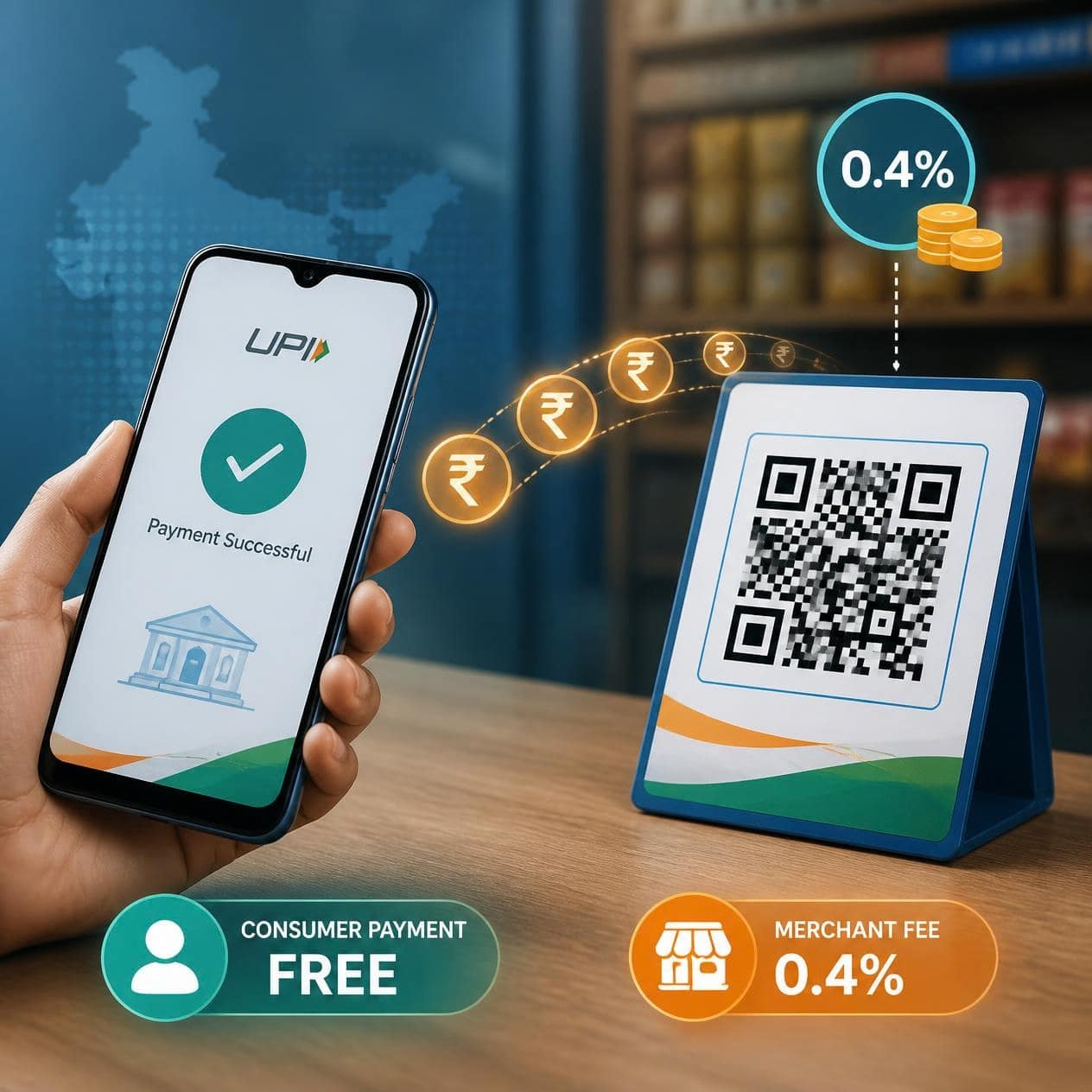
For six years, “UPI is free” has been one of the most repeated lines in Indian fintech. That claim is now being tested — and a lot of misinformation is filling the gap. Here is what has actually changed, what hasn’t, and the fair arguments on both sides.
A Quick Timeline: How We Got Here
- 2016–2019: UPI launches and grows slowly. Banks were still allowed to charge small fees on IMPS/UPI transactions in this early period.
- January 2020: The government removed the Merchant Discount Rate (MDR) on person-to-merchant (P2M) UPI transactions entirely. This is the moment “zero-MDR UPI” became policy — merchants paid nothing to accept UPI, and banks/NPCI absorbed the cost, partly offset by a government incentive scheme (₹3,631 crore paid out in 2023-24 alone).
- 2020–2025: UPI usage explodes — from about ₹21.3 lakh crore in FY 2019-20 to over ₹260 lakh crore by March 2025. Zero-MDR was widely credited as a key reason merchants and small vendors adopted it so fast.
- September–October 2026: The government reintroduces a limited MDR — and this is the change fueling the “UPI is no longer free” narrative online.
What Actually Changed (September–October 2026)
Two things happened almost simultaneously, and conflating them is where most of the confusion comes from:
1. A notification protecting small transactions. On September 14, 2026, the Finance Ministry notified (S.O. 5067(E)) that banks and payment providers cannot charge any fee, direct or indirect, on UPI or RuPay debit card transactions up to ₹2,000 — for both individuals and merchants. This was framed as a consumer-protection move, not a new tax.
2. A new Merchant Discount Rate above ₹2,000, effective October 15, 2026. From that date, a 0.4% MDR applies to person-to-merchant (P2M) UPI payments above ₹2,000, capped at ₹300 per transaction for payments of ₹75,000 or more. Some categories (like mutual funds, stockbroking, and select institutional payments) face flat charges instead of the percentage rate.
Crucially:
- This is not GST, and it is not a tax on the public. The Finance Ministry explicitly denied reports of GST on UPI transactions, calling them “completely false, misleading, and without any basis.” GST applies to goods or services bought via UPI, not to the payment rail itself.
- Peer-to-peer (P2P) transfers — sending money to friends, family, splitting a bill — remain completely free, regardless of amount.
- The 0.4% MDR is charged to the merchant, not deducted from the customer’s payment. It’s the same mechanism used for credit/debit card acceptance, just at a much lower rate.
- Small merchants below a certain turnover threshold are expected to remain exempt under the framework.
So the accurate headline isn’t “UPI is now taxed.” It’s: “Large merchants accepting UPI above ₹2,000 will now pay a small processing fee, similar to card payments — consumers and P2P transfers are unaffected.”
Why the Government Made This Change
The official reasoning, and the reasoning offered by industry bodies, centers on a few points:
- Zero-MDR was never actually free — someone was paying for the infrastructure. Banks and NPCI absorbed the cost, subsidized partly by taxpayer-funded incentive payouts (over ₹3,600 crore in one year). At UPI’s current scale (500+ crore transactions a month), that subsidy model is seen as increasingly unsustainable.
- Parity with other payment rails. Credit and debit cards carry MDR; UPI has not, which some argue distorted competition and left banks with little incentive to invest in UPI infrastructure and fraud prevention.
- Funding UPI’s future growth, including international expansion and infrastructure investment, without leaning entirely on the exchequer.
Pros and Cons
Arguments in favor:
- Keeps 99%+ of everyday UPI usage (P2P and small P2M payments) completely free — this covers the vast majority of ordinary citizens’ daily use.
- Reduces the long-term subsidy burden on public funds.
- Brings UPI’s merchant economics closer to global digital payment norms, potentially improving service quality and fraud protection.
- 0.4% is still far cheaper than credit card MDR (typically 1.5–3%), so merchants aren’t being pushed back toward cash.
Arguments of concern:
- Large or high-ticket merchants (electronics, travel, real estate brokers, etc.) will pass the cost to consumers through price adjustments, even if indirectly.
- Trust erosion: UPI’s “always free” branding was central to its adoption story, especially for small vendors and rural users; any charge — even one they don’t pay — creates confusion and skepticism.
- Misinformation risk: as seen this week, rumors of “GST on UPI” spread faster than the government’s clarifications, which can dent confidence in digital payments generally.
- Small businesses just above informal thresholds worry about being caught by the new MDR as their transaction volumes grow.
The Bigger Question: Is This “Ache Din,” and Does Policy Keep Shifting on the Public?
This is where the article moves from facts to genuinely contested political territory, and it’s worth being upfront about that rather than picking a side.
One perspective (often voiced by critics) is that India’s economic policy — GST slab changes, fuel pricing, fee structures, cess additions — has shifted frequently enough that ordinary citizens feel like the rules of daily financial life are unstable, and that promises of “free” services get quietly walked back once adoption is locked in. In this reading, the UPI MDR reintroduction fits a broader pattern of policy flux that erodes public trust, even when the technical fine print says consumers aren’t directly charged.
Another perspective (offered by the government and much of the payments industry) is that policy should evolve as a system matures — what made sense to subsidize UPI to 100 crore+ users in 2020 doesn’t need to be subsidized the same way in 2026, and reintroducing a merchant-side fee, well below card rates, while explicitly protecting small transactions and consumers, is a sign of a maturing, sustainable digital economy rather than a broken promise.
Both views have real merit, and reasonable people land differently depending on how much weight they give to (a) the letter of the policy (consumers remain unaffected) versus (b) the psychological and trust effects of any change to something branded as permanently free, and (c) how downstream costs eventually flow to consumers via pricing.
Whether this counts as “ache din” delivered or denied is ultimately a judgment about broader economic experience — inflation, employment, cost of living — not something this single UPI change can answer on its own. It’s worth evaluating on its own facts (limited, merchant-side, consumer-protected) rather than folding it into every other economic grievance, even though it’s understandable that people do.
Bottom Line for the Public
- If you’re an individual sending or receiving money via UPI — to friends, family, or paying most small shopkeepers — nothing changes for you. It remains free.
- If you’re a large merchant or making high-value payments (above ₹2,000) to certain categories of businesses, there may be a small 0.4% cost on the merchant side from October 15, 2026.
- There is no GST and no new tax on UPI transactions despite viral claims to the contrary — this has been directly and repeatedly denied by the Finance Ministry.
- Keep an eye on official NPCI and Finance Ministry FAQs rather than social media claims, since this is an evolving policy area with a lot of misinformation circulating.
This article reflects the policy position as of September 16, 2026. The MDR framework takes effect October 15, 2026, and further clarifications from NPCI or the Finance Ministry may follow.