


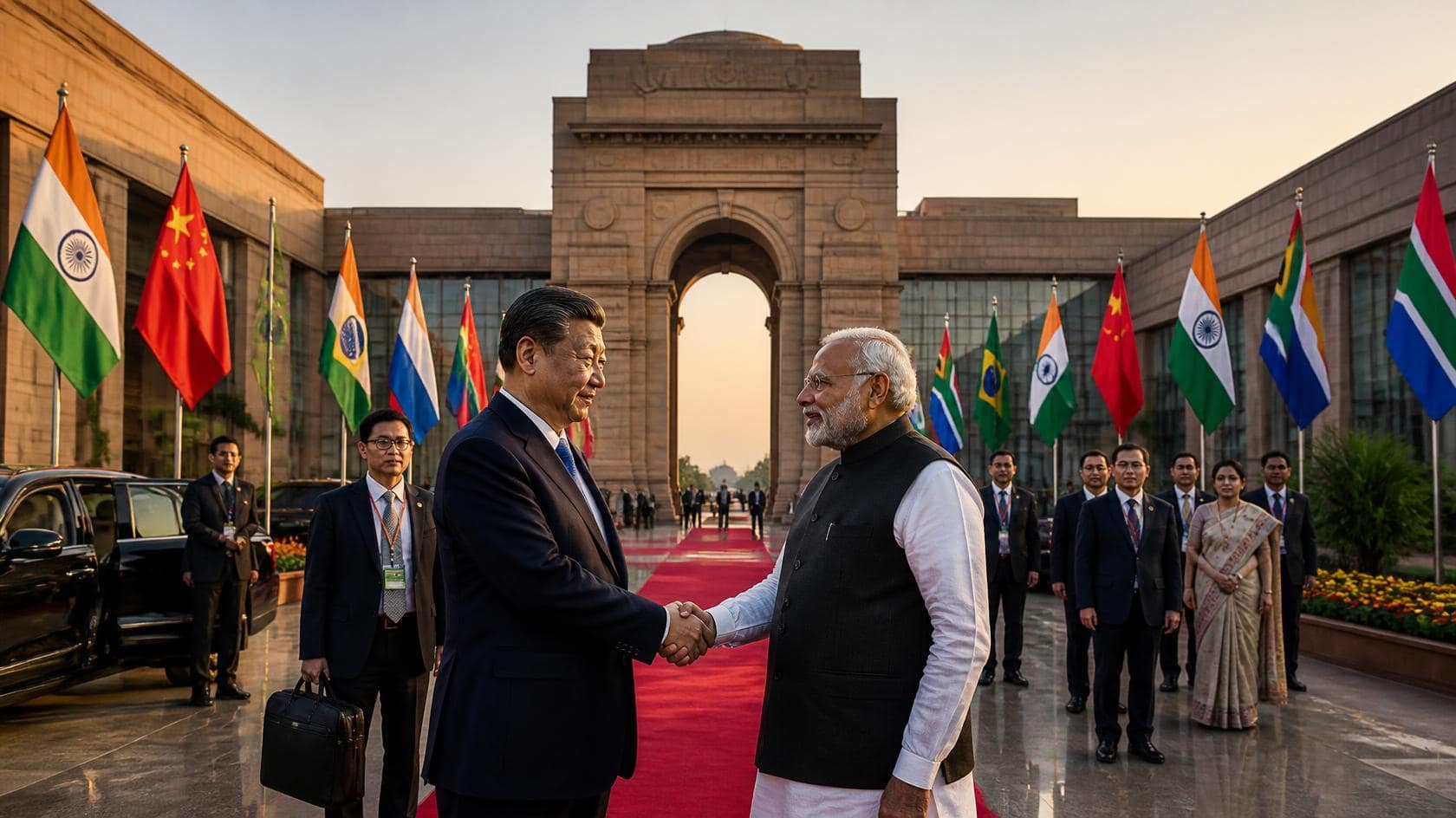
On September 12–13, 2026, New Delhi’s Bharat Mandapam will host the 18th BRICS Summit, bringing together leaders from 11 member nations at what’s shaping up to be one of India’s biggest diplomatic moments of the year. This isn’t just another multilateral photo-op — it marks BRICS’ 20th anniversary, India’s fourth time chairing the group, and, notably, Chinese President Xi Jinping’s first visit to India since 2019.
Here’s a simple breakdown of what BRICS is, why this particular summit matters, and what to watch for.
What Is BRICS, and Who’s In It Now?
BRICS started in 2009 as a loose grouping of just four countries — Brazil, Russia, India, and China (South Africa joined in 2010, making it “BRICS”). It was built around a simple idea: give major emerging economies a stronger, more coordinated voice in global affairs, historically dominated by the US, Europe, and institutions like the G7.
Since 2024, the group has expanded significantly. BRICS now has 11 full members:
Brazil, Russia, India, China, South Africa, Egypt, Ethiopia, Iran, Indonesia, Saudi Arabia, and the United Arab Emirates.
Together, these countries represent roughly 49.5% of the world’s population, about 40% of global GDP, and around 26% of global trade — which is exactly why a meeting like this draws global attention, even though it isn’t as widely covered in Western media as the G7 or G20.
Why Is This Summit Happening Now, and Why New Delhi?
India took over the BRICS chairship on January 1, 2026 — its fourth time holding this role, after 2012, 2016, and 2021. Under India’s leadership this year, over 350 meetings and high-level engagements have already taken place across more than 25 Indian cities, building up to this leaders’ summit as the culmination.
India’s chairship theme is “Building for Resilience, Innovation, Cooperation and Sustainability” — organized around four pillars:
- Resilience — protecting economies and institutions from supply-chain shocks, health crises, and climate risks
- Innovation — cooperation on AI, fintech, and digital infrastructure
- Cooperation — expanding trade routes, development financing, and economic alignment
- Sustainability — climate-resilient infrastructure and shared environmental goals
A BRICS Business Forum and a Women’s Business Alliance session will run on September 11, just ahead of the main leaders’ summit on September 12–13.
Who’s Attending — and Why That’s the Real Story
This year’s guest list is what’s generating most of the buzz, for one specific reason: both Xi Jinping and Vladimir Putin are attending in person.
- Xi Jinping’s visit will be his first trip to India since the informal Chennai summit in October 2019 — and his first since the deadly 2020 Galwan Valley clash, which froze high-level bilateral visits between India and China for years. A bilateral meeting between Xi and Putin is also reportedly planned on the sidelines.
- Vladimir Putin confirmed his in-person attendance through a Kremlin aide, notable because Putin has skipped previous BRICS summits in person (attending virtually when South Africa hosted in 2023).
- Iranian President Masoud Pezeshkian is also expected to attend.
- Beyond the 11 full members, BRICS now works with 10 partner countries — Belarus, Bolivia, Cuba, Kazakhstan, Malaysia, Nigeria, Thailand, Uganda, Uzbekistan, and Vietnam — some of whom may send delegations as outreach invitees.
For India specifically, hosting Xi in person — after years of icy relations following the border clash — is being read as a signal of cautious, incremental thaw between the two countries, even as the underlying border disputes remain unresolved.
What’s Actually on the Agenda?
Beyond the diplomatic optics, several concrete initiatives are expected to be discussed or formalized:
- BRICS Global Value Chains Action Plan (2026–2030) — aimed at strengthening trade corridors and supporting export-oriented small and medium enterprises across member nations.
- Voluntary Principles for Climate-Resilient Urban Infrastructure — a framework for building cities that can better withstand climate shocks.
- Digital public infrastructure cooperation — India is expected to push its own DPI experience (UPI, Aadhaar-style systems) as a model other BRICS nations could adapt.
- Discussions on global governance reform — a recurring BRICS theme, generally centered on giving emerging economies more representation in institutions like the UN Security Council and IMF.
- Energy security and agriculture cooperation, particularly relevant given ongoing global supply disruptions tied to the Russia-Ukraine war and Middle East tensions.
Why This Matters Beyond the Summit Itself
A few reasons this particular meeting carries weight beyond the usual diplomatic calendar:
- It’s a 20th-anniversary moment for BRICS — a chance for the bloc to demonstrate it’s evolved from a symbolic grouping into a body capable of coordinated economic action.
- It’s a geopolitical bellwether. With the US pursuing tariff-heavy trade policies and Western alliances under strain in various ways, BRICS increasingly positions itself as a counterweight — a platform for countries seeking alternatives to dollar-dominated trade and Western-led institutions.
- India’s own positioning matters. Hosting Xi and Putin together, while India also maintains close ties with the US and the West, reflects India’s long-standing strategy of “multi-alignment” — engaging multiple blocs without fully committing to any one camp.
- It could reset India-China dynamics. Xi’s visit, even framed narrowly around BRICS business, is the most significant in-person opportunity in years for the two countries to signal whether post-Galwan tensions are genuinely easing.
The Bottom Line
The 18th BRICS Summit is more than a routine diplomatic gathering — it’s a marker of how much the bloc has grown (from 5 to 11 members), a rare in-person meeting between Xi Jinping and Vladimir Putin on Indian soil, and a test of whether India-China relations are genuinely thawing after years of tension. Whatever comes out of the formal agenda — trade frameworks, climate principles, or governance statements — the optics of who shows up, and how they’re received, will likely be the story most people remember from September 12–13.
FAQs
What is the theme of India’s 2026 BRICS chairship? “Building for Resilience, Innovation, Cooperation and Sustainability,” organized around four pillars covering economic resilience, technology cooperation, trade expansion, and climate-resilient development.
Which countries are BRICS members in 2026? Brazil, Russia, India, China, South Africa, Egypt, Ethiopia, Iran, Indonesia, Saudi Arabia, and the United Arab Emirates — 11 full members in total.
Is this Xi Jinping’s first visit to India since the border clash? Yes. Xi’s visit for the 2026 BRICS Summit will be his first trip to India since the informal Chennai summit in October 2019, and his first since the 2020 Galwan Valley clash that badly strained India-China relations.
Where exactly is the summit being held? At Bharat Mandapam in New Delhi — the same venue that hosted the 2023 G20 Summit — on September 12–13, 2026, preceded by a Business Forum on September 11.
This article is intended for general information and current-affairs awareness. Details around attendance and agenda items may evolve as the summit approaches.
Sources
- ANI / The Tribune, “BRICS Summit 2026: Key likely outcomes as India drives a transformative global agenda in New Delhi”
- Ministry of External Affairs, India (Press Release), “18th BRICS Summit, 12–13 September, New Delhi”
- Newsable Asianet News, “India to Host 18th BRICS Summit in New Delhi in September 2026”
- Outlook India, “Xi, Putin May Visit India During BRICS Summit 2026”
- Ground News / Deccan Herald, “BRICS Summit 2026: Chinese President Xi Jinping Likely To Visit India In September”
- Deccan Herald, “President Putin to attend BRICS summit in New Delhi on Sep 12-13: Kremlin aide”
- Wikipedia, “18th BRICS summit”