


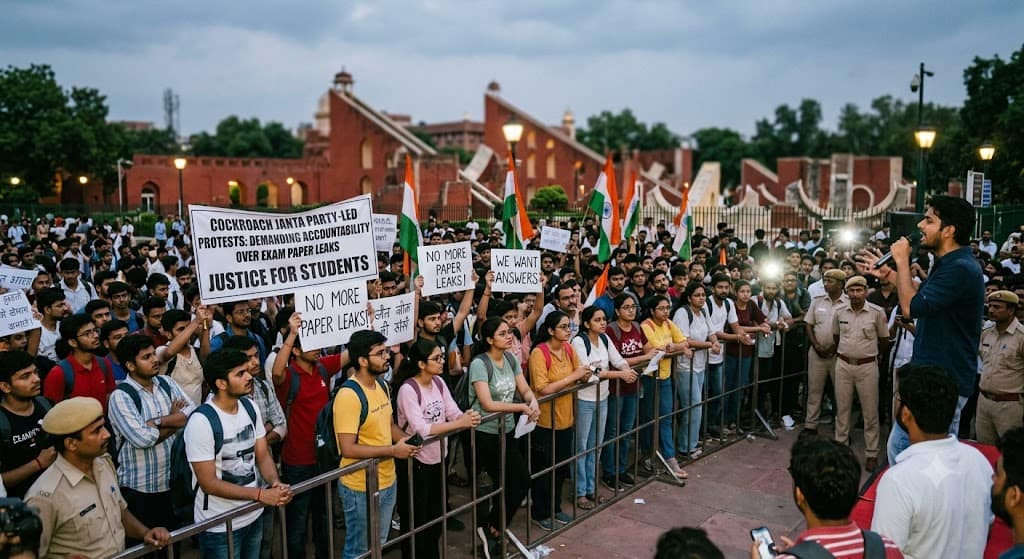
A satirical Instagram page has grown into the biggest youth protest India has seen in years — and it looks nothing like the movements that came before it.
For weeks, the heart of New Delhi has belonged to teenagers and twenty-somethings. At Jantar Mantar, the capital’s designated protest ground, thousands of students have gathered under the banner of a self-declared “political party” named after a cockroach. What started in May 2026 as an online joke has, by July, become a nationwide reckoning over exam fraud, youth unemployment, and a generation’s frustration with India’s institutions.
Here’s what’s happening, why it looks so different from past student uprisings, and how it fits into India’s long history of youth-led dissent.
What sparked the protests
The trigger was almost accidental. In mid-May, Chief Justice Surya Kant made a remark during a court hearing that was widely interpreted as comparing India’s unemployed youth to cockroaches, saying they struggle to find work or a place in any profession. He later clarified he was referring to people using fake degrees to enter certain jobs — but by then the comment had already struck a nerve in a country where youth unemployment remains stubbornly high.
Within days, a group of young Indians turned the insult into a symbol. A parody Instagram page called the Cockroach Janta Party (CJP) — a pointed pun on the ruling Bharatiya Janata Party — was launched by communications strategist Abhijeet Dipke. It flooded social media with memes, mock campaign slogans, and short satirical videos mocking corruption and joblessness. The account’s growth was startling: within about a week, its Instagram following had overtaken that of the ruling party’s own official page.
The satire soon found a real-world cause. In June, revelations about a leaked NEET (medical entrance exam) paper and irregularities in the CBSE’s on-screen marking system gave the online movement an offline mission. On June 6, 2026, CJP held its first protest at Jantar Mantar alongside established student organizations, demanding the resignation of Union Education Minister Dharmendra Pradhan over the scandals.
The protests gained a second, more solemn face when veteran education reformer and Ladakh activist Sonam Wangchuk joined in solidarity, beginning an indefinite hunger strike at the protest site in late June. After weeks of escalating demonstrations, anger intensified further when Wangchuk was forcibly removed from the protest site and hospitalized following his prolonged fast — a moment that, for many young protesters, cemented the movement’s stakes.
Why this protest looks different
Unlike India’s older protest traditions — built around parties, unions, or charismatic single leaders — the CJP movement is deliberately leaderless in spirit and driven by irony rather than conventional political messaging.
It started as a meme, not a manifesto. The party’s own materials lean into absurdity: prospective “members” were told the job requirements included being unemployed, chronically online, and skilled at ranting. Even its manifesto uses exaggerated, tongue-in-cheek language — including one proposal that election officials accused of wrongly removing voters from electoral rolls face the same legal treatment as terrorism suspects — to dramatize what protesters see as institutional failure. Serious grievances are being voiced through comedy rather than traditional slogans.
It’s built for the feed, not just the rally. AI-generated cockroach mascots, reels, and viral captions have done the work that pamphlets and party workers once did. Organizers describe the approach as meeting a generation raised on memes and short-form video on its own terms, rather than through conventional political messaging.
It doesn’t map onto old political lines. CJP presents itself as a protest against the system as a whole rather than an endorsement of any opposition party, even as opposition politicians have voiced support for its demands. Its founder has said the party isn’t formally affiliated with any political organization.
It escalated fast — and faced force. What began as sit-ins turned confrontational when protesters attempted to march toward Parliament. Students breached security barricades and were met with tear gas and baton charges from Delhi Police, images of which spread quickly online and hardened public sympathy for the demonstrators.
Social media’s central role
Social media isn’t just amplifying this movement — it effectively created it. The original CJP account went from a joke among friends to a mass movement in roughly a week, a growth rate normally associated with viral entertainment content rather than political organizing.
Three dynamics stand out:
- Speed of mobilization. Students traveled overnight from small towns to Delhi within days of the first call to protest, coordinated almost entirely through Instagram and messaging apps rather than through party infrastructure.
- Meme literacy as political language. Humor and irony have let young protesters discuss sensitive topics — unemployment, exam corruption, allegations of electoral roll manipulation — without sounding like traditional activists, making the content more shareable and harder for critics to dismiss outright.
- Global visibility. International outlets, and even commentary on Chinese social media, picked up on the moment, turning a domestic grievance into a story being watched well beyond India’s borders.
Social media has also opened the movement to criticism from within. Some young Indians argue it centers the frustrations of relatively privileged, urban, internet-connected youth rather than those who have long faced the sharpest edges of India’s institutional failures — a debate that continues to play out in the comments sections of the very platforms that built the movement.
How it compares to earlier Indian student movements
India has no shortage of youth-driven protest history, but this movement breaks from the pattern in several ways.
The 2011 anti-corruption movement led by Anna Hazare relied on a single, older figurehead, structured hunger strikes, and formal civil-society organizing — eventually spawning a political party of its own (the Aam Aadmi Party). The CJP movement echoes the hunger-strike tactic through Wangchuk, but its day-to-day energy comes from anonymous, crowd-sourced online content rather than one figure’s speeches and public appearances.
The 2019–2020 anti-CAA/NRC protests, centered on university campuses like JNU and Jamia Millia Islamia, were driven by a specific piece of legislation and coordinated heavily through campus student unions and civil-rights groups. The current movement is less tied to any single campus and spreads through a decentralized online network before converging physically at Jantar Mantar.
Earlier campus movements typically built power through student unions with formal leadership hierarchies. CJP’s structure is closer to a brand than an organization — a shared symbol and aesthetic (the cockroach, the satire, the color red) that anyone can adopt and remix, lowering the barrier to participation.
What connects all of them is the underlying grievance: young Indians, who make up roughly half the country’s population, repeatedly feeling that the institutions meant to serve them — education, employment, elections — are failing to deliver a fair shot.
What happens next
The movement notched its first major win on July 25, 2026, when Dharmendra Pradhan resigned as education minister, submitting his resignation to Prime Minister Modi. In his resignation post, Pradhan said he respected the aspirations of the country’s youth and did not want protesting students to be exploited by outside interests or entangled in legal trouble instead of focusing on their studies. CJP founder Abhijeet Dipke declared victory to cheering crowds at Jantar Mantar, where authorities had restricted internet access and shut down nearby metro stations amid the standoff.
The resignation came days after Delhi Police used batons, tear gas, and reportedly pellet guns against students marching toward Parliament — a crackdown that appears to have accelerated the government’s decision to concede. Senior BJP ministers have since held rounds of talks with CJP representatives, and opposition leaders, including Congress’s Rahul Gandhi, have publicly congratulated the protesters.
But Pradhan’s exit was only one of the movement’s demands; students have also called for scrapping the National Testing Agency and broader reforms to how public exams are conducted. Whether the government moves on those remaining demands — and whether CJP can convert this early win into lasting influence beyond a single resignation — is the question that will define the movement’s next phase.