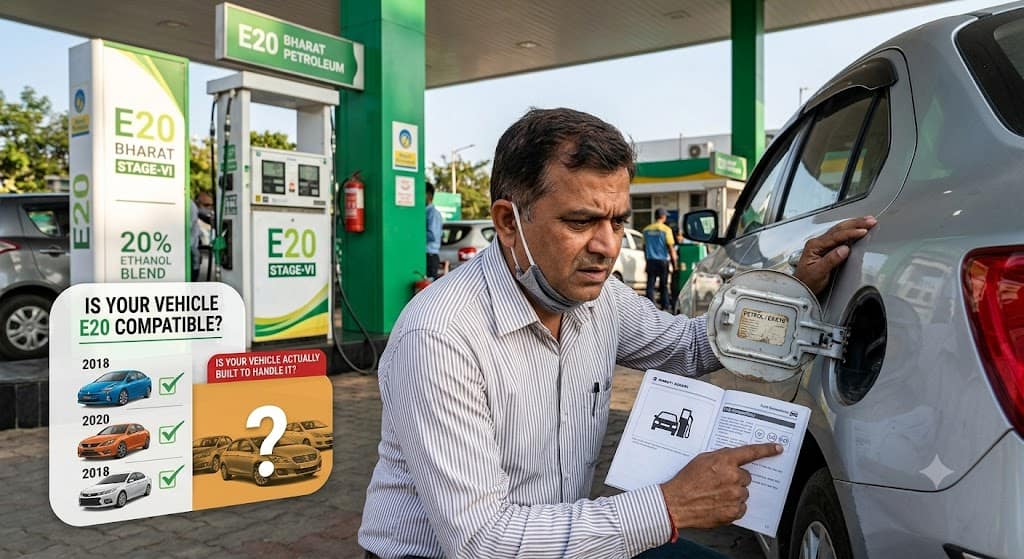
If you’ve filled up at an Indian petrol pump recently, you may have noticed a small sticker on the nozzle mentioning “E20” or “ethanol blended.” It isn’t a marketing gimmick — it’s part of one of the biggest fuel policy shifts in the country’s history. And going by search trends, it’s also one of the most confusing changes for the average vehicle owner. Questions like “Is ethanol better than petrol?”, “Will E20 damage my bike?”, and “Which cars support E20?” are searched every single day, month after month — not because of one news cycle, but because millions of people are living this transition in real time, one fill-up at a time.
Here’s a complete, practical breakdown.
1. What Is Ethanol?
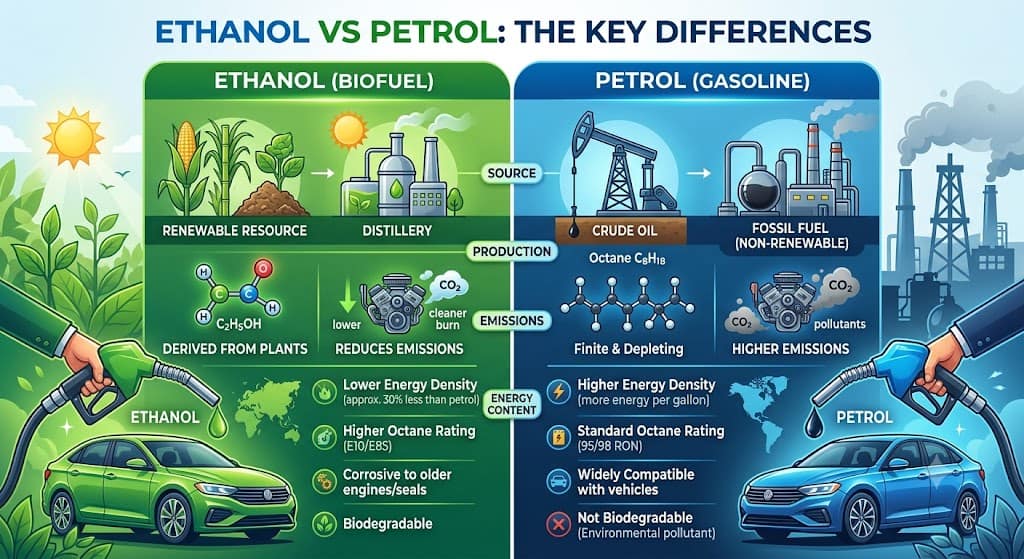
Ethanol is a form of alcohol produced from plant-based sources. In fuel form, it acts as an oxygenate — meaning it helps petrol burn more completely, which reduces harmful emissions like carbon monoxide. It’s the same basic chemical family as drinking alcohol, but fuel-grade ethanol is processed and denatured specifically for combustion, not consumption.
2. What Is Petrol?
Petrol (or gasoline) is a fossil fuel refined from crude oil. It has been the standard fuel for two-wheelers and cars for over a century, valued for its energy density and wide availability — but it comes with the twin costs of import dependence and higher tailpipe emissions.
3. How Is Ethanol Made?
In India, ethanol is produced mainly from:
- Sugarcane (and its by-products like molasses and sugarcane juice) — the largest source historically
- Maize (corn) — a rapidly growing source as the government has pushed diversification
- Damaged food grains and surplus rice — used at times to boost supply
- Other agricultural residues, in smaller volumes
This is essentially a fermentation and distillation process, similar in principle to how alcohol is brewed, but scaled industrially and directed toward fuel-grade purity.
4. Why Is India Promoting Ethanol Blending?
This is the heart of the story, and it’s less about your bike’s mileage and more about national economics.
India imports the vast majority of its crude oil, which makes it vulnerable to global price swings and geopolitical shocks. Blending petrol with domestically produced ethanol is a direct way to cut that import bill. According to the Ministry of Petroleum and Natural Gas, the ethanol blending program has already saved the country roughly ₹1.06 trillion (around $12 billion) in crude oil imports and avoided an estimated 54.4 million tonnes of carbon emissions over the past decade — comparable to taking about 12 million petrol cars off the road for a year.
There’s also a rural economy angle: ethanol production creates a steady market for sugarcane and maize farmers, helping clear sugarcane payment arrears and improving the economics of maize cultivation. And environmentally, government-backed studies suggest ethanol from sugarcane and maize produces significantly lower lifecycle greenhouse gas emissions than pure petrol.
In short: India isn’t promoting ethanol primarily to make your commute cheaper — it’s doing it to reduce oil import dependence, support farmers, and cut national emissions. Any consumer-level fuel savings are a secondary effect, not the primary goal.
5. What Is E20 Fuel?
E20 is petrol blended with 20% ethanol and 80% conventional petrol. India previously ran on E10 (10% ethanol) for years before ramping up. The country officially hit its 20% blending target in 2025 — notably, about five years ahead of the original schedule — and E20 is now available at a large and growing number of pumps nationwide.
The government has also gone a step further: new standards (IS 19850:2026) for even higher blends — E22, E25, E27, and E30 — were notified in 2026, effective from May 15, 2026, signaling that India’s ethanol roadmap doesn’t stop at E20.
6. Ethanol vs Petrol: Comparison Table
| Factor | Petrol (E0/E10) | Ethanol-Blended (E20) |
|---|---|---|
| Price | Slightly higher per litre (import-dependent) | Marginally cheaper in theory, though savings haven’t fully reached consumers yet |
| Mileage | Baseline | Typically 1–6% lower, depending on vehicle age and tuning |
| Engine Compatibility | Universal | Requires E20-compatible engine, seals, and fuel lines |
| Pollution | Higher CO and particulate emissions | Lower carbon monoxide; ~30% lower emissions than E10 per government studies |
| Performance | Standard combustion | Higher octane (~108.5 vs petrol’s ~84.4) can improve acceleration in tuned engines |
| Maintenance | Standard servicing | May need more frequent fuel filter checks; moisture sensitivity in tanks |
7. Can Old Vehicles Use E20?
This is where most of the real-world friction is happening. Vehicles manufactured before March 2023 were generally designed for E10 or lower blends. Running E20 in these older engines can cause:
- Corrosion of rubber seals, gaskets, and hoses not built for ethanol’s corrosive properties
- Rough idling, harder cold starts, and clogged fuel filters
- A more noticeable mileage drop — the government itself has acknowledged this can go up to around 6% in older vehicles, compared to just 1–2% in newer, E20-compliant ones
Some two-wheeler manufacturers and fuel retailers have publicly cautioned that pre-2023 vehicles may need fuel-system modifications, and that any resulting damage would fall outside standard warranty coverage. The safest approach: check your owner’s manual or manufacturer’s official E20-compatibility list before assuming your vehicle is fine.
8. Which Companies Manufacture E20-Compatible Vehicles?
Most major Indian manufacturers have shifted their new lineups to E20 compatibility, including:
- Maruti Suzuki
- Hyundai
- Honda (cars and two-wheelers)
- Tata Motors
- Several two-wheeler brands, following government mandates that made E20-readiness standard for new vehicles from around April 2023 onward
If you’re buying new today, it’s very likely E20-ready. If you’re driving something older, verification is essential.
9. Advantages and Disadvantages
Advantages:
- Reduces India’s crude oil import bill significantly
- Cuts vehicular carbon and particulate emissions
- Supports farmers and the rural economy through sugarcane and maize demand
- Higher octane can improve performance in engines built for it
- Aligns with India’s Net Zero by 2070 commitment
Disadvantages:
- Real mileage drop, especially in older vehicles
- Corrosion risk for non-compatible fuel systems
- Diverts food crops (maize, rice, sugarcane) toward fuel, raising questions about food security and land use
- Consumer-facing pricing benefits haven’t been passed on the way policy think tanks originally recommended
- Retrofitting or upgrading older vehicles adds cost for owners who didn’t choose this transition
10. Frequently Asked Questions
Is ethanol better than petrol?
It depends on the lens. Environmentally and strategically (for the country), yes — lower emissions and reduced import dependence. For an individual owner of an older vehicle, the trade-offs in mileage and maintenance can feel like a downgrade.
Can ethanol damage my bike or car?
It can, if your vehicle isn’t built for it. Non-compatible engines face real risks of corrosion and reduced efficiency. E20-compliant vehicles are engineered to handle it safely.
What is E20 fuel?
Petrol blended with 20% ethanol and 80% conventional petrol — now the standard blend across much of India.
Which vehicles support E20 petrol?
Most vehicles manufactured from around April 2023 onward. Always confirm via your owner’s manual or manufacturer’s compatibility list.
Will ethanol reduce fuel prices for consumers?
Not conclusively yet. While ethanol is cheaper to produce domestically than importing crude, those savings have not been fully or consistently passed on to consumers at the pump, which is a major source of the current public frustration.
Sources referenced: Ministry of Petroleum and Natural Gas (Government of India) press releases; Bureau of Indian Standards notification IS 19850:2026; industry and news reporting on India’s ethanol blending programme.