


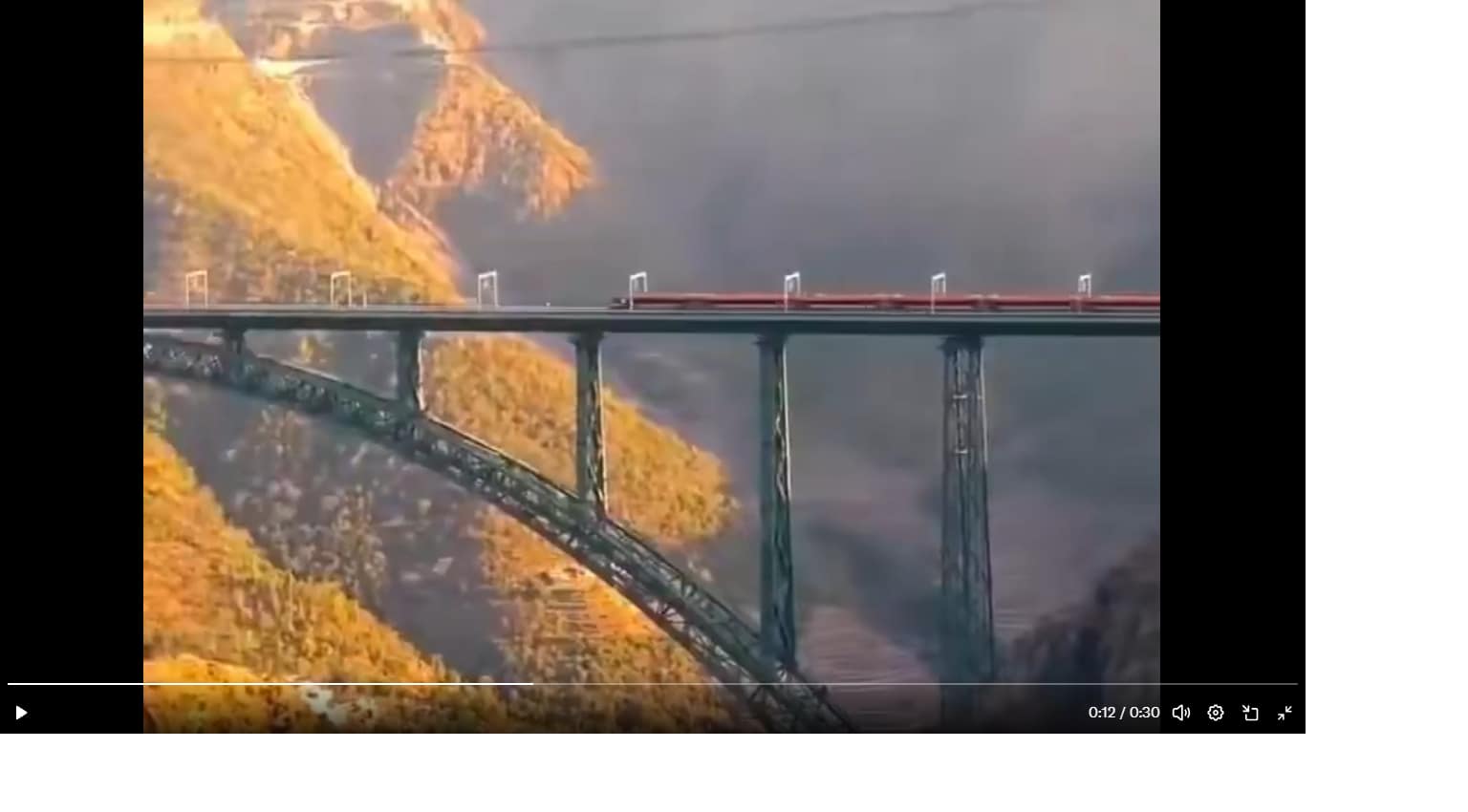
A Train Ride Like No Other on Earth
Picture a sleek, aerodynamic train gliding silently across a steel arch suspended nearly 359 meters above a roaring Himalayan river — higher than the Eiffel Tower, higher than the Qutub Minar stacked on itself several times over. This isn’t a scene from science fiction. It’s the everyday reality of the Vande Bharat Express crossing the Chenab Bridge in Jammu & Kashmir, one of the most breathtaking rail journeys anywhere in the world.
This single stretch of track represents decades of ambition, extreme engineering, and national resolve — finally connecting the Kashmir Valley to the rest of India by rail.
What Is the Chenab Bridge?
The Chenab Rail Bridge is the centerpiece of the Udhampur–Srinagar–Baramulla Rail Link (USBRL) project, a mission first conceived in 1983 and finally realized decades later. Located in the Reasi district of Jammu & Kashmir, the bridge connects the Kauri and Bakkal stations across the Chenab River gorge.
Key facts about the Chenab Bridge:
- Height: 359 meters (1,178 feet) above the riverbed — the world’s highest railway bridge
- Total length: 1,315 meters, made up of a 785-meter steel deck arch and a 530-meter approach bridge
- Design life: Engineered to last 120 years
- Wind resistance: Built to withstand wind speeds up to 266 km/h
- Seismic rating: Designed to survive earthquakes up to magnitude 8
- Materials: Blast-resistant steel with advanced corrosion-proof coatings for extreme Himalayan weather
It is, without exaggeration, one of the most technically demanding bridges ever constructed — built through some of the most seismically active and geologically unstable terrain on the planet.
The Historic First Crossing
The Vande Bharat Express made its first trial run across the Chenab Bridge on January 25, 2024, traveling from Shri Mata Vaishno Devi Katra to Budgam and back. Crowds gathered at stations along the route to witness the moment a modern, indigenously built train conquered a bridge many once thought impossible to construct.
Commercial operations began in earnest after Prime Minister Narendra Modi inaugurated the Katra–Srinagar Vande Bharat Express service on June 6, 2025, officially opening the final missing link of the USBRL project and connecting the Kashmir Valley to the Indian rail network for the first time in history.
The Katra–Srinagar Vande Bharat Route
Two Vande Bharat Express train sets now run daily between Katra and Srinagar, covering approximately 189 km through some of the most dramatic scenery in India:
- Train numbers: 26401/26402 and 26403/26404
- Route highlights: Crossing the Chenab Bridge and the Anji Khad Bridge (India’s first cable-stayed railway bridge), and threading through the Pir Panjal range’s network of tunnels
- Onboard features: Wi-Fi, infotainment systems, large panoramic windows, and comfortable reclining seats
Because of the extreme cold of the Kashmir Valley, this particular Vande Bharat rake has been specially modified with insulated pipes, bio-toilet tanks resistant to freezing, and windshield defrost systems for clear visibility even in sub-zero temperatures.
Why the Chenab Bridge Matters
The significance of this engineering marvel goes far beyond scenic value:
1. National Connectivity — For the first time, the Kashmir Valley is linked to the Indian rail network year-round, independent of weather-disrupted road routes.
2. Tourism Growth — The journey itself has become a destination, drawing rail enthusiasts and tourists eager to experience the world’s highest railway bridge firsthand.
3. Strategic and Economic Value — Faster, more reliable transport strengthens logistics, trade, and regional development across Jammu & Kashmir.
4. Engineering Prestige — The bridge stands as a global showcase of Indian infrastructure capability, built to withstand extreme wind, seismic activity, and decades of Himalayan winters.
The Bigger Picture: A New Era for Indian Railways
The Vande Bharat Express crossing the Chenab Bridge is more than a single journey — it’s a symbol of how far Indian rail infrastructure has come. What began as a near-impossible engineering challenge in 1983 became, over four decades later, a fully operational high-speed rail link through some of the world’s most unforgiving terrain.
For travelers, it means a smoother, faster, and genuinely spectacular way to reach the Kashmir Valley. For India, it’s a landmark achievement in modern engineering — proof that even the highest mountains and deepest gorges can be bridged with vision, precision, and persistence.
Planning a trip on the Katra–Srinagar Vande Bharat Express? Book well in advance, especially for weekend travel, as demand for this scenic route remains high year-round.