


Introduction
Imagine buying a flat in Mumbai, paying crores for it, registering the sale deed — and still not appearing anywhere in the government’s official land records. That has been the reality for millions of apartment owners across India for decades.
Now, Maharashtra is rewriting the rules. With the introduction of Vertical Property Cards (VPC), the state is doing something radical: giving every individual flat its own government-recognised legal identity — not just on paper, but in official land records. Announced by Chief Minister Devendra Fadnavis and mandatory for all new flat registrations from 1 January 2026, this reform could reshape urban property ownership across India.
Here’s everything you need to know.
What Are Vertical Property Cards?
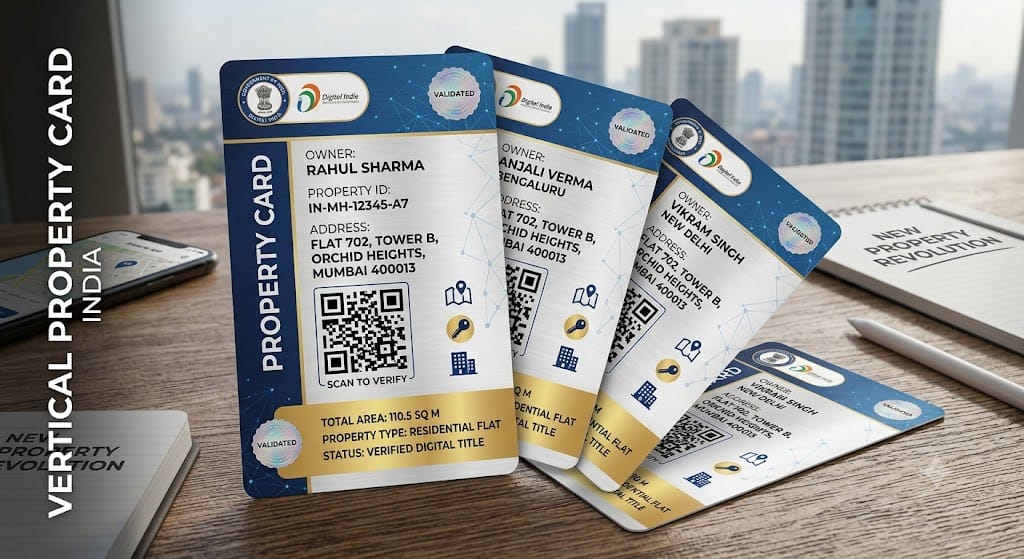
A Vertical Property Card is a legally issued, digitally authenticated government document that records an individual flat owner’s ownership rights — including their proportional share of the land beneath the building — directly within official state land records.
Think of it as the apartment equivalent of the traditional Property Card or the rural 7/12 extract. Where those documents record land ownership for individual plots, the VPC does the same for each flat in a multi-storey building.
Each VPC captures:
- The flat owner’s name
- Flat number and floor
- Carpet area (in sq. ft.)
- The owner’s proportionate share of the land beneath the building
- Details of any active bank loan or mortgage
- A link to the 7/12 extract (or its urban equivalent)
- A digitally verifiable QR code for tamper-proof authentication
In short, for the first time, your flat gets its own official government identity — not just a sale deed tucked in a folder, but a live record in the state’s digital registry.
Why Are They Needed? The Problem With India’s Existing System
India’s land record system was built for a horizontal world — for plots of land, not towers of flats. Here’s how the gap developed:
The Traditional System Didn’t Account for Vertical Living
Under the current system, official land records — whether property cards in urban Maharashtra or 7/12 extracts in rural areas — typically list only the landowner. In the case of a housing society, that means the society or builder appears in the record, not the individual flat owner.
When you buy a flat, you receive a registered sale deed and a share certificate from the housing society. These documents establish your rights, but they sit outside the government’s land record ecosystem. You are, legally, the owner of your flat — but the state’s records don’t reflect that.
The Scale of the Problem
Maharashtra alone has over 1.65 crore flat owners who currently lack individual entries in official land records. With Indian cities expanding vertically at a rapid pace — nearly half of Maharashtra’s population now lives in urban areas — the gap between how people own property and how the state records it has become enormous.
What This Gap Causes
- Disputed ownership: Without flat-level government records, ownership disputes are harder to resolve, especially during redevelopment of older buildings.
- Loan complications: Banks often require multiple documents — sale deed, society NOC, share certificate — to verify ownership before sanctioning a home loan.
- Slow transactions: Resale and inheritance processes can drag on for months due to unclear documentation chains.
- Fraud vulnerability: The absence of a centralised, government-verified record makes it easier for unscrupulous actors to sell the same flat to multiple buyers or forge documents.
How Are Vertical Property Cards Different From Existing Property Documents?
| Feature | Sale Deed | Share Certificate | Vertical Property Card |
|---|---|---|---|
| Issued by | Sub-registrar | Housing society | State Revenue Department |
| Appears in govt. land records | No | No | Yes |
| Records land share | No | No | Yes |
| Digitally verifiable | No | No | Yes |
| Links to 7/12 / Property Card | No | No | Yes |
| Useful for home loans | Partially | Partially | Fully |
The most important distinction: a sale deed proves you bought a flat. A VPC proves the government recognises you as the owner, with a defined share in the land beneath — something that has never existed for Indian flat owners before.
How Is the Land Share Calculated?
The VPC assigns each flat owner a proportionate share of the building’s underlying land based on a straightforward formula:
Your carpet area ÷ Total carpet area of all flats in the building = Your land share
For example, if your 1,000 sq. ft. flat is in a building with a total carpet area of 50,000 sq. ft., you hold a 2% share in the land on which the building stands. This proportion is formally recorded in government records — exactly the kind of clarity that urban property ownership in India has lacked for generations.
Benefits for Flat Owners
1. You Become a Legally Recognised Landowner
Previously, flat owners had indirect rights over the land. The VPC makes you a formally recognised landowner, with your name and share entered in official state records — similar to how a farmer’s name appears on a 7/12 extract.
2. Faster Home Loans
Banks can verify your ownership with a single authenticated digital document. No more chasing NOCs, share certificates, and multiple paper records. Experts say this could significantly cut the time and friction involved in home loan approvals.
3. Smoother Resale and Inheritance
What used to take months — verifying title, getting society clearances, tracing ownership history — becomes dramatically simpler when a clear, government-backed record is available. This is especially important for inheritance, where unclear documentation often leads to family disputes or prolonged legal processes.
4. Stronger Position in Redevelopment Negotiations
Redevelopment of older housing societies in Mumbai and Pune has historically been contentious, partly because individual ownership stakes in the land were not clearly recorded. With VPCs, each flat owner’s land share is documented, making negotiations more transparent and equitable.
5. Protection Against Fraud
The digital, QR-enabled format makes VPCs tamper-resistant. Because each flat has an individual entry in the government registry, it becomes significantly harder to fraudulently sell the same property to multiple buyers.
Benefits for Banks and the Government
For Banks
Lenders get a single, verified, government-issued document that confirms ownership, land share, and existing encumbrances. This reduces credit risk, speeds up due diligence, and could potentially improve access to formal housing finance for a wider range of buyers.
For the Government
Clearer property records mean more accurate property tax assessments over time. They also reduce the burden on courts and revenue offices, where a significant number of cases relate to property ownership disputes. A digital, linked record system also supports the broader Digital India vision of creating transparent, accessible public services.
How Does It Work? The Implementation Plan
Maharashtra’s rollout is phased:
- Mandatory for new registrations from 1 January 2026: Every new flat registration in Maharashtra must now include a Vertical Property Card. Registration cannot be completed without one.
- Opt-in window for existing owners: Existing flat owners can apply through their housing society for ₹500 per flat. The government has waived measurement costs of ₹8,000 per property as part of the Svamitva vertical-7/12 initiative.
- Deadline for existing owners: The application window closes in December 2027. Societies that do not act by this date risk their members missing out on permanent land ownership recognition.
- Pilot cities: Nagpur has already seen approximately 45,000 units mapped under the Svamitva vertical-7/12 pilot.
An eight-member high-level committee was formed in late 2025 to frame the final “Vertical Property Rules” — the legislative framework that standardises how ownership will be recorded across the state.
Challenges in Implementation
No reform of this scale comes without hurdles.
Legacy Properties Are Complex
Older housing societies — many built before RERA, some decades old — may have incomplete or inconsistent documentation. Calculating and verifying land shares for these buildings will require significant effort.
Digital Infrastructure Gaps
Not all municipal areas have the same level of digital readiness. Tier-2 and Tier-3 cities may face delays in rolling out the system uniformly.
Awareness Among Existing Owners
Many flat owners — particularly in older societies — are unaware of the VPC system, its benefits, or the December 2027 deadline. Poor outreach could leave a large number of people without coverage.
Policy vs. Implementation
Legal experts have noted that while the policy has strong backing, statewide uniform implementation depends on the completion of the formal legislative and administrative framework. Getting every district surveyed, mapped, and aligned is a time-intensive process.
What Does This Mean for India’s Real Estate Market?
Maharashtra is the first state to attempt flat-wise land records at this scale, and experts believe the model could be adopted nationally if it succeeds.
Industry leaders have compared the VPC to an Aadhaar number for every residential unit — a unique, verifiable identifier that links multiple data points (ownership, area, loan status) into a single, accessible record.
For buyers, the confidence that comes from knowing your ownership is government-backed, clearly documented, and digitally verifiable is enormous. For developers, projects with clean VPC-aligned documentation are likely to command greater buyer trust. For lenders, faster title verification means lower transaction costs.
India’s real estate ease-of-doing-business ranking has historically lagged global peers — countries like China and Singapore register property in fewer than five days, compared to India’s much longer timelines. Reforms like the VPC are a step toward closing that gap.
Conclusion
The Vertical Property Card is not just a piece of paper. It is the state formally acknowledging that millions of Indians who live in flats are, in every meaningful sense, landowners — and deserve the same legal recognition that a farmer gets for a plot of agricultural land.
If Maharashtra executes this reform well, it could become the blueprint for a national transformation of urban property records, one that reduces disputes, speeds up transactions, protects buyers, and brings India’s real estate administration in line with global standards.
For anyone who owns, is buying, or is planning to buy a flat — this is a reform worth following closely.