


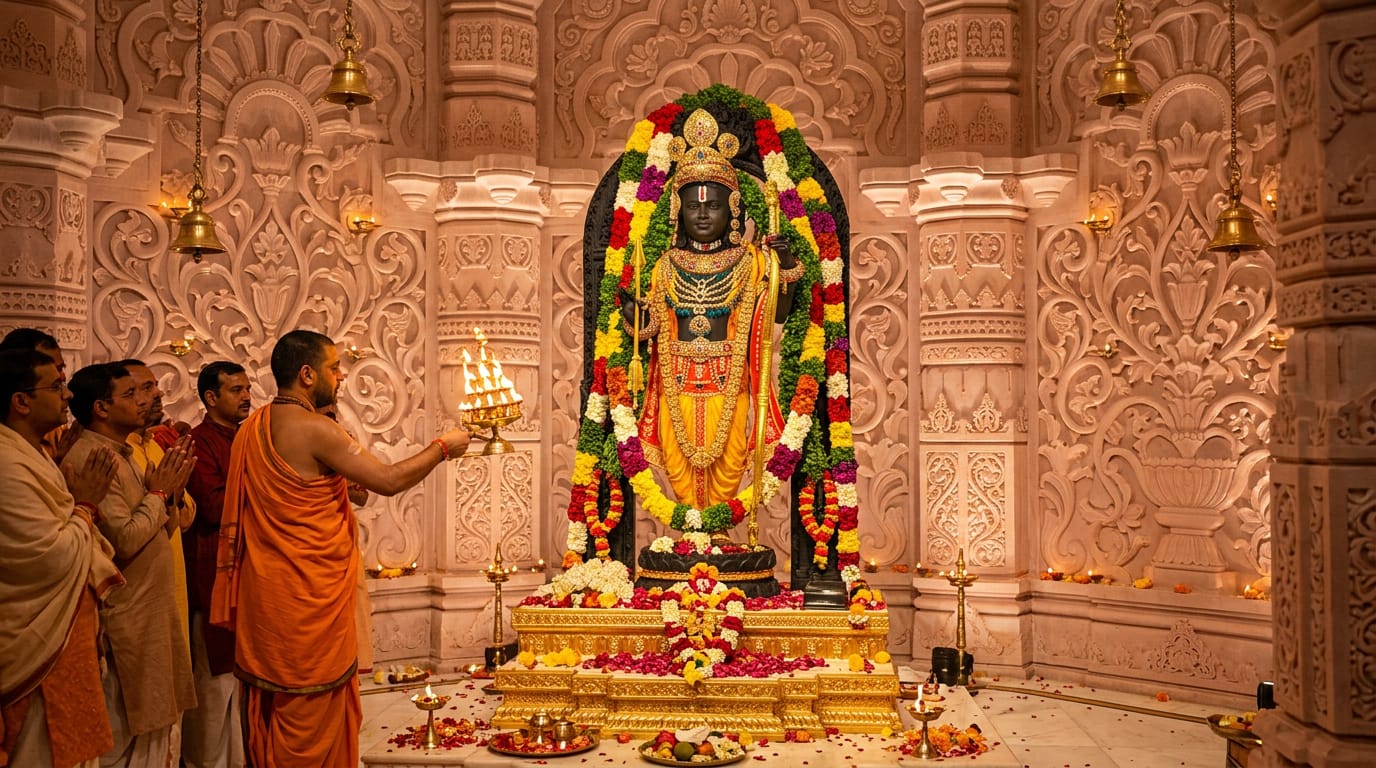
Hey Ram… Jai Shri Ram…
We hope this letter finds you well — though honestly, we’re not sure where you are right now. Are you in Ayodhya? In the forest again? Or have you quietly slipped away to the jungle because you realised that Vanaras, Valmiki’s ashram, and even Ravana’s Lanka were far more civilised than the people living around your temple today?
Because Ram, things are happening inside and around your temple that even Ravana — for all his faults — would be ashamed of.
They installed your statue. They performed Prana Pratishtha. They breathed life into that beautiful stone, and you became a Sadguru Moorthy — a living deity.
And yet… can you not see what is happening in your name?
Your donation box. Your gold. Your silver. Your offerings. All being quietly — and very efficiently — swaha’d.
We know you are the all-seeing, all-knowing Purushottam. So tell us honestly, Ram — are you surprised by the people of this Yuga? Because we are not. This generation is ready to sell anything. Gods. Goddesses. Sacred trusts. Everything has a price. Everything has a commission.
Now Ram, before you get angry, please hear us out.
We have a few complaints of our own — and since you started it by setting some rather complicated precedents, we feel it is only fair that you listen.
First — you left Sita.
Just like that. No court notice. No lawyer. No alimony hearing. No decree. You simply said, “Public is talking,” and off she went to Valmiki’s ashram — pregnant, alone, no questions asked.
Ram, do you have any idea how difficult that is in today’s world?
If we try to leave our wives, they don’t quietly go to an ashram. They go to a lawyer. Then the case runs for several years. The court fees alone will empty our hundi. And if the decree finally comes — crores in settlement, property division, maintenance… Ram, leaving a wife in this Yuga is not a simple forest walk. It is a financial catastrophe.
So please — do not judge us too harshly.
Second — about your sons.
Ram, you were a king. A Chakravarti. And yet… Luv and Kush grew up in a forest ashram. No school fees. No coaching classes. No engineering college donations. No capitation fees. Valmiki himself was their guru — and his fees? Zero.
We are not so lucky.
Our children need school admissions — lakhs of rupees. Then college — more lakhs. Then coaching for entrance exams — still more lakhs. Where does this money come from, Ram? From our salary? Ha!
So yes — when we saw your hundi overflowing with devotion, we thought: “Ram himself will understand. He knows what education costs. He knows our struggle.”
And so — with full faith in your compassion — we borrowed a little. From your donation box. For our children’s future. You are after all Karunasagar — the ocean of mercy. Surely you won’t mind.
Third — about the investigation.
Ram, in your Yuga — no SIT. No ED. No CBI. No Income Tax. No Enforcement Directorate. Nobody asked you anything. Not even about Sita. Not about the Agni Pariksha. Nothing.
We are not so fortunate.
The moment the hundi money went missing, they formed an SIT. Then the Supreme Court got a petition. Then the CBI was demanded. Investigating officers keep changing — every new officer has a different version of the story. The case will drag on for years. By the time judgement comes, we will be old men, Ram. And for an old man — what is the difference between a prison and a home? Both have a bed, both have food, both have people who ignore you.
So we are not very worried.
And finally Ram — a word of gratitude.
Because without you, none of this would have been possible.
If your temple had not been built — after decades of legal battles, political drama, and historic Supreme Court verdicts — where would we ordinary people have found access to such generous amounts of gold, silver, and cash donations in one place?
You made it possible, Ram.
You are truly Maryada Purushottam — the protector of dignity and boundaries. You protected our maryada by giving us this golden opportunity.
Thank you, Ram. From the bottom of our hearts — and the bottom of your hundi.
Jai Shri Ram.
This is a work of satire. It is written in the great Indian tradition of speaking truth through humour — with deep respect for faith, and deep frustration with those who exploit it.