


Karnataka is not West Bengal. Our problems are real but different. The solution should be too.
First, Acknowledge the Real Problem
You are right on multiple counts. And it is important to separate two completely different issues that are getting mixed up in the national SIR debate.
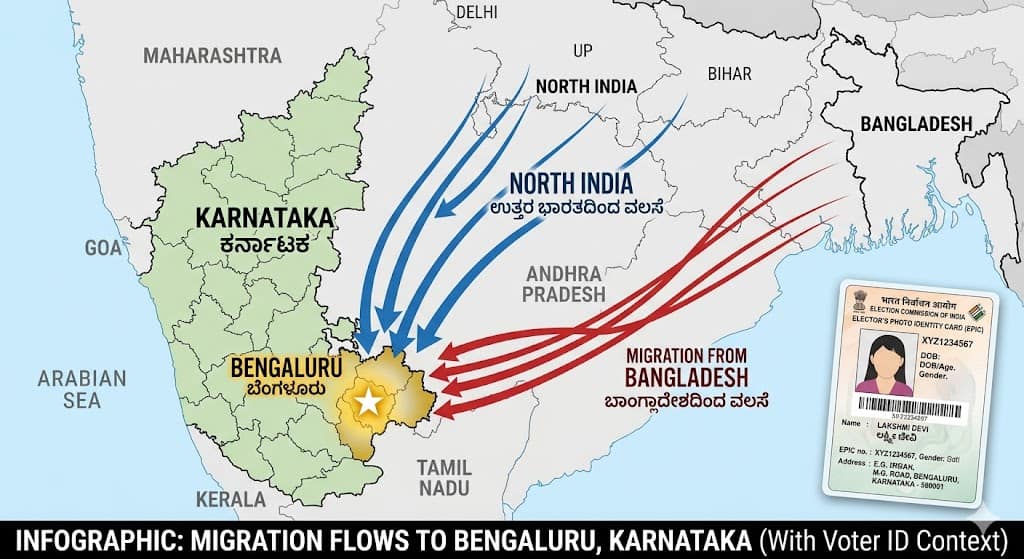
Issue 1: North Indian migrant workers — from Bihar, UP, Rajasthan, Odisha — who come to Bengaluru for work in construction sites, hotels, restaurants, and factories, stay for a few months, earn money, and go back. They are Indian citizens. They have every right to be here. They are not on Karnataka’s voter rolls and should not be.
Issue 2: Bangladeshi nationals — documented or undocumented — who have made their way to Karnataka. In October 2024, Bengaluru City Police initiated a crackdown on illegal immigration and arrested illegal migrants from Pakistan and Bangladesh. This is a real, documented problem — not a political invention.
These are two completely separate issues. SIR treats both the same way — by knocking on every door. That is where the problem begins.
What Karnataka’s Government Itself Has Said
Karnataka Food and Civil Supplies Minister K.H. Muniyappa expressed concern over the SIR of electoral rolls, alleging its misuse has created confusion and suspicion across the country. A meeting chaired by Chief Minister Siddaramaiah was held with various organisations to discuss issues related to the SIR exercise, including concerns over its misuse and ways to prevent irregularities.
Muniyappa’s warning was sharp and specific. He said: “In West Bengal, many people claim that the government lost power because of alleged SIR manipulation. Analysts say that due to such manipulation, BJP won nearly 100 seats by margins of around 5,000 votes. This should not be allowed in Karnataka and we are careful.”
This is the Karnataka government itself — the Congress government — saying loudly that it fears the SIR could be misused here the same way it was in Bengal.
Karnataka’s Specific Voter Roll Problems — Are They Real?
To be fair to the Election Commission, Karnataka does have genuine voter roll issues. But they are very different from Bengal’s. Let us look at them honestly.
Problem 1: The Bengaluru IT Migration Explosion
Bengaluru is the fastest-growing major city in India. Millions of people have moved here from other states and other parts of Karnataka in the last 20 years. Many of them are registered in their home villages or home towns but physically live in Bengaluru. Their names exist in two places — their hometown rolls and potentially Bengaluru rolls if they re-registered. Urban zones such as Bengaluru, Whitefield, Electronic City, Yelahanka and other high-migration areas face stricter scrutiny under SIR.
This duplication problem is real and legitimate to fix.
Problem 2: Seasonal North Indian Workers
Hundreds of thousands of workers from North India come to Bengaluru every year — for construction, hospitality, domestic work, and manufacturing. They live here for three to eight months, earn their wages, and return home. They are not registered on Karnataka’s voter rolls. They vote in their home states. This is not a voter roll problem at all. SIR cannot and should not touch them.
Problem 3: Bangladeshi Nationals in Bengaluru
Karnataka Home Minister G. Parameshwara confirmed that verification of Bangladeshi nationals would be carried out continuously — not just in Bengaluru but also in coffee estates and other areas across Karnataka. He said: “Those living illegally in Karnataka will be identified. The police will inspect coffee estates and question estate owners about their labourers. If Bangladeshis are found, they will be immediately arrested and sent to jail.”
But these Bangladeshi nationals living in Karnataka, doing daily labour, have no Indian government documents. They have no voter ID. They have no Aadhaar. They have no ration card. They are not on any voter roll anywhere in India. SIR cannot detect them. SIR only checks people who are already on voter rolls. Someone with zero documents is invisible to SIR.
This means the biggest security concern in Karnataka — undocumented Bangladeshis — is precisely the group that SIR will completely miss. The police, immigration authorities, and local intelligence are far better equipped to find them than a BLO going door to door with a checklist.
So What Will SIR Actually Do in Karnataka?
Based on evidence from other states and Karnataka’s specific ground reality, here is what is likely to happen:
What it will achieve legitimately:
- Remove names of deceased voters who were never struck off
- Identify duplicate registrations of people who re-registered in Bengaluru after moving from their home district
- Add new voters who turned 18 since the last update
- Update addresses for people who moved within Karnataka
What it will struggle with:
- Migrant workers from other states with inconsistent addresses — their names may be flagged even though they are genuine Indian citizens registered in their home states
- People with name spelling mismatches between voter ID and Aadhaar — a very common problem in Karnataka where names are transliterated differently in Kannada and English
- Women who changed surnames after marriage — a significant source of mismatches
What it will completely fail at:
- Detecting undocumented Bangladeshis who have no voter ID in the first place
- Identifying any illegal immigrant who stayed completely off official records
- Solving the temporary migrant worker problem which is not a voter roll issue at all
The Political Concern — Is Karnataka Being Set Up?
Muniyappa said clearly: “What is happening is that names of those who should remain are being retained selectively, while others are being removed.” He added: “Democracy cannot survive through misuse of power.”
Karnataka’s next assembly election is in 2028. The BJP will be fighting hard to return to power. The Congress government is watching the West Bengal outcome — where 9.1 million names were removed from voter rolls, and the BJP scored a historic upset ending Mamata Banerjee’s 15-year rule — with great alarm.
The fear in Karnataka’s Congress government is not irrational. The SIR schedule for Karnataka has BLO visits running from June 30 to July 29, 2026, with the final roll published October 7, 2026. That is two years before the next state election — giving time for deletions to be challenged. But the precedent set in Bengal, where genuine voters were deleted and could not vote before appeals were resolved, is deeply worrying.
What Karnataka Actually Needs Instead of a Full SIR
Your instinct is right. Karnataka’s problems are specific, manageable, and do not require the blunt instrument of a full SIR. Here is what would work better:
For duplicate registrations: A simple Aadhaar-voter ID cross-check exercise using existing databases would find all duplicates in weeks — without a single BLO visiting a single home.
For deceased voters: Automatic death certificate linkage with municipal and panchayat offices. Karnataka has a reasonably good civil registration system. Use it.
For Bangladeshi infiltrators: This is a police and immigration matter — not an electoral matter. The Karnataka Police, IB, and FRRO are the right agencies. Karnataka Home Minister Parameshwara already confirmed a continuous verification drive across the state. That is the right approach. SIR is the wrong tool for this job.
For seasonal North Indian workers: No action needed. They are not on Karnataka’s rolls. They are not a problem.
For new voters and address updates: The existing continuous updation system — Form 6 for new registration, Form 8 for address change — works perfectly fine if properly publicised.
The Final Verdict on Karnataka’s SIR
Karnataka does not have a Bangladesh border. It does not have decades of refugee inflow and demographic anxiety. It does not have the specific infiltration problem that Assam and West Bengal have. It has a genuine but manageable voter roll maintenance problem that technology can solve far more accurately and far less disruptively than door-to-door verification.
The legitimate problems are real but small. The risks of misuse — as the Karnataka government itself has warned — are large.
Karnataka needs smart, database-driven voter roll maintenance. It does not need a political tool disguised as an administrative exercise — especially when the same tool just helped overturn 15 years of democratic mandate in the state next door.