


Chennai | May 12, 2026
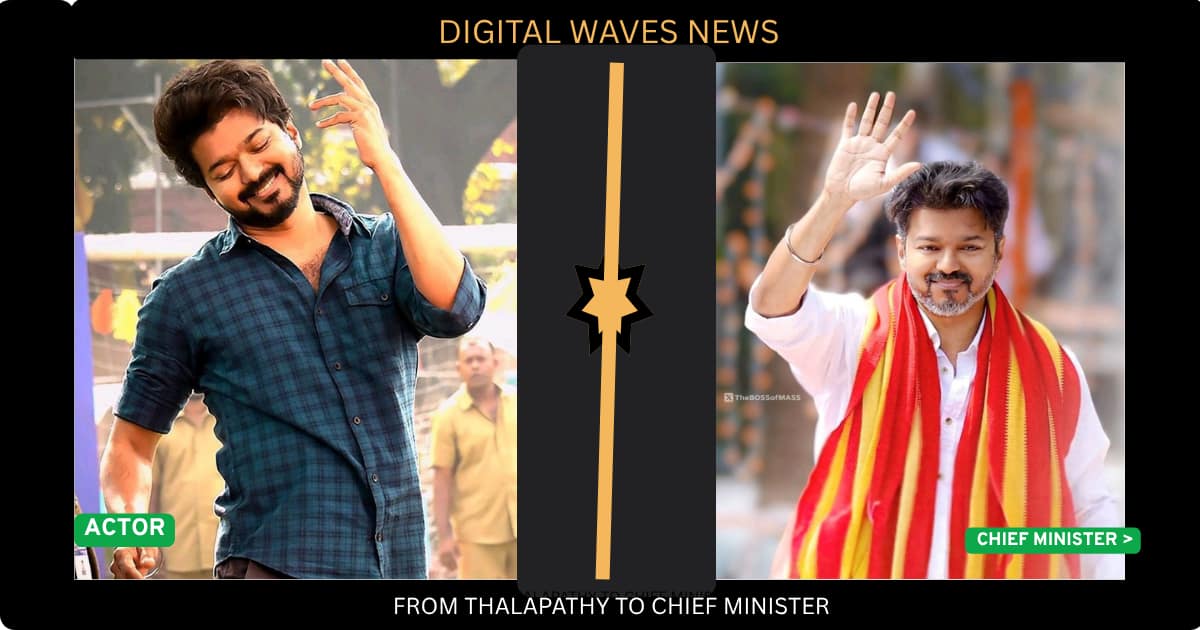
There’s a saying in Tamil Nadu that goes: when a Vijay film releases, the whole state holds its breath. For three decades, that was the kind of power Chandrasekaran Joseph Vijay held — not as a politician, not as a bureaucrat, but as a movie star. Now, that same man sits in the Chief Minister’s chair. And somehow, it feels like the whole state saw it coming.
The Boy Behind the Camera
Vijay was born on June 22, 1974, in Madras — now Chennai. His father, S. A. Chandrasekhar, is a filmmaker, and his mother Shoba Chandrasekhar is an accomplished playback singer. Growing up in a household soaked in Tamil cinema, acting wasn’t so much a choice as it was an inevitability.
His early steps as a lead actor were anything but smooth. Vijay played the lead role for the first time in Naalaiya Theerpu at the age of 18 in 1992. The film failed at the box office, with Vijay receiving bitter criticism for his looks and performance. Most young men would have retreated. Vijay doubled down.
Finding His Footing — and His Fans
His breakthrough came with Senthoorapandi (1993), where he starred alongside established hero Vijayakanth. The film was a hit, boosting Vijay’s popularity with the masses. Then in 1994, Rasigan ran for more than 175 days in theatres, and Vijay became popular as “Ilaya Thalapathy” — the Young Commander.
The late 1990s cemented his stardom. He rose to fame with romance films such as Poove Unakkaga (1996), Love Today (1997), Kadhalukku Mariyadhai (1997) and Thullatha Manamum Thullum (1999). Kadhalukku Mariyadhai earned him his first Tamil Nadu State Film Award for Best Actor.
But romance could only carry him so far. The success of his masala film Thirumalai (2003) changed his on-screen persona to that of an action hero. He appeared next as a kabaddi player in Ghilli (2004), which went on to become the most commercially successful Tamil film of the year.
The Era of Thalapathy
Through the 2010s, Vijay wasn’t just acting in blockbusters — he was using the screen as a platform. He refined his “angry young man” image with socially conscious roles in Thalaivaa (2013), Thupakki (2012), Kaththi (2014), Mersal (2017), and Bigil (2019). These weren’t just entertainers. Films like Mersal took direct aim at government healthcare failures and the GST rollout, sparking national debates.
His major commercial successes of this era included Thuppakki (2012), Kaththi (2014), Mersal (2017), Sarkar (2018), Master (2021), Leo (2023), and The Greatest of All Time (2024), which rank among the highest-grossing Tamil films of all time.
Many noted that his 2018 film Sarkar, in which he plays a businessman who runs for office after confronting electoral fraud, was an early indication of his political ambitions.
By the time his final film Jana Nayagan (“People’s Hero”) was announced, Vijay was reportedly paid more than $30 million for the film — making him one of the highest-paid actors in all of India.
Fan Clubs, Welfare Work, and the Seeds of a Party
What sets Vijay apart from other superstar-politicians isn’t just fame — it’s organisation. In July 2009, he organised his fan clubs — reportedly numbering around 85,000 across Tamil Nadu — under the umbrella of a welfare association called Vijay Makkal Iyakkam. Over the years, this evolved into something far more substantial than fan meetups, running schools, student welfare programmes, and community outreach across the state.
His political instincts sharpened gradually and publicly. He made occasional political statements, such as condemning the Citizenship (Amendment) Act in February 2019, and criticising other political parties in an event in June 2023.
Then, on February 2, 2024, he made it official. Vijay announced the launch of his political party, Tamilaga Vettri Kazhagam (TVK), and stated his intent to contest the 2026 Tamil Nadu assembly elections. The party’s name translates to “Victory Party of Tamilakam.” Its principles: egalitarianism, secularism, and social justice. Its declared opponents: the DMK for alleged corruption and dynastic politics, and the BJP for right-wing ideology.
A Historic Election — and a Tragic Campaign Trail
The road to power wasn’t without heartbreak. On September 27, 2025, during a campaign rally in Karur, a crowd crush resulted in the deaths of at least 41 people and left 80 others injured. Vijay announced personal compensation for victims’ families and suspended campaigning temporarily. The tragedy led to a CBI inquiry, and political rivals sought to use it against him. It didn’t stick.
Elections were held on April 23, 2026, and recorded the highest voter turnout in Tamil Nadu’s history at 85.1%. The results were stunning. TVK, in its very first election, emerged as the single largest party, winning 108 out of 234 seats, ending a 59-year streak of dominance by Dravidian parties in the state.
The outgoing Chief Minister M. K. Stalin of the DMK lost his own seat — the constituency he had won three times consecutively. Meanwhile, Vijay contested from two constituencies and won both.
TVK secured the alliance of the Indian National Congress, along with support from the Communist Party of India, CPI(M), Viduthalai Chiruthaigal Katchi, and the Indian Union Muslim League, enabling it to form a government.
Governor Rajendra Arlekar administered the oath of office to Vijay at the Jawaharlal Nehru Indoor Stadium in Chennai on May 10, 2026 — making him the 22nd Chief Minister of Tamil Nadu, and the first leader of a non-Dravidian party to hold that office since 1967.
What Kind of Leader Will He Be?
Analysts have drawn comparisons to M. G. Ramachandran and Jayalalithaa — both former actors who converted screen stardom into political dynasties. But Vijay’s supporters insist he represents something different: a genuine break from the Dravidian duopoly, rather than a continuation of it.
Analysts attributed TVK’s success to the anti-incumbency against the DMK government, Vijay’s mobilisation of his fanclubs into a unified party, and the party’s strong digital campaign portraying itself as a fresh, corruption-free alternative.
His first three days in office have been anything but quiet. The order to shut 717 TASMAC liquor outlets near sensitive areas signals a leader eager to make early statements — on governance, on public welfare, and on the distance he intends to keep from the political playbook of his predecessors.