


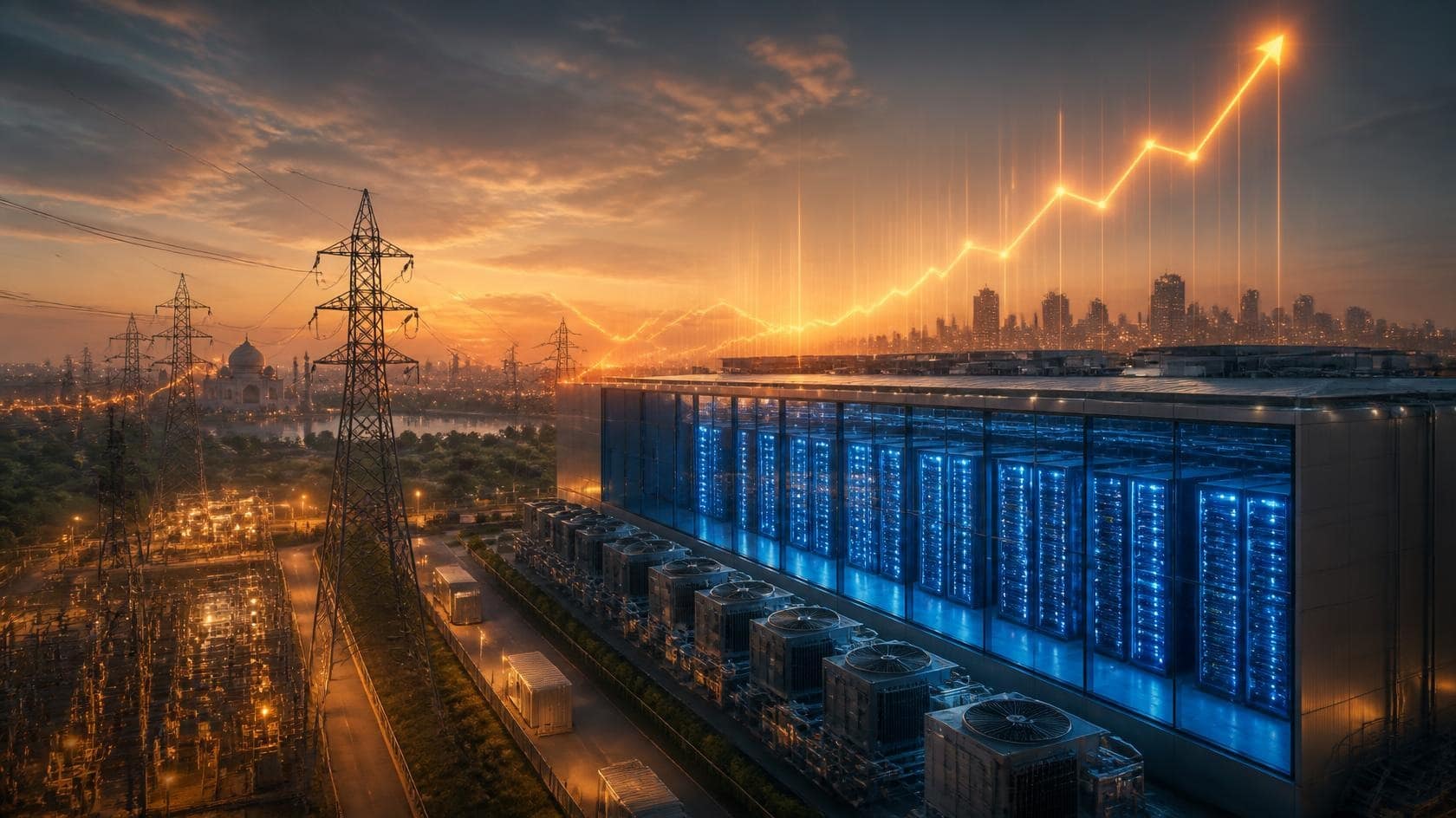
India wants to be one of the world’s biggest homes for cloud computing and artificial intelligence. The catch is that data centres run around the clock and use enormous amounts of power. As the government shapes its India data centre policy, one question matters to every household and business: who pays for the electricity?
Why India Is Betting Big on Data Centres
India generates a huge share of the world’s data but hosts little of the infrastructure to store and process it. India accounts for nearly 20% of the world’s data but has only about 3% of global data centre capacity. outlookbusiness
Several forces are driving the rush to build:
- Digital adoption: India had 1.09 billion internet subscribers as of March 2026. pwonlyias
- Data localisation: Government policy has encouraged domestic storage, alongside growth in cloud adoption and enterprise digitisation. outlookbusiness
- AI demand: Training and running AI models requires dense, power-hungry computing.
The growth is already visible. Installed data centre power capacity rose from roughly 375 MW in 2020 to about 1.57 GW by August 2026. Forecasts see much more to come. Wood Mackenzie projects operational capacity rising from 2.2 GW in 2025 to 12 GW by 2030, with AI-dedicated capacity growing nearly 24-fold. Capacity figures differ between reports because they measure different things, so treat them as indicators of direction rather than exact counts. policyedgeenergetica-india
What the Policy Offers Investors
The proposed National Data Centre Policy is aimed at making India a more attractive location for global operators. The draft proposes a 20-year tax holiday for operators that meet milestones on capacity addition, energy use and job creation, plus “essential services” status and dedicated data centre economic zones. As of that report, the national policy was still in draft stage, though several states already have their own data centre policies. teletele
The Union Budget has also sweetened the deal. It added a tax holiday until 2047 for notified foreign cloud companies serving global customers through India-based data centres. Industry estimates point to a large prize: a KPMG report cites a $90 billion opportunity across the data centre value chain by FY35. policyedgeangelone
The Power Problem
This is where the story gets complicated. Data centres need uninterrupted electricity and heavy cooling, and the demand forecasts are rising fast.
Official and independent estimates vary:
- The Ministry of Power estimated data centre demand at 13.56 GW by 2031-32. w
- Internal ministry projections cited in July 2026 reach 26 GW by 2032 and 35.7 GW by 2040. angelone
- Wood Mackenzie expects data centre electricity use to grow 20-fold by 2040, from 10 TWh in 2025 to about 7% of national demand. energetica-india
Location adds to the strain. Maharashtra and Tamil Nadu account for around 65% of installed IT load. The Ministry of Power is reportedly considering policy changes, including locating data centres away from urban centres to ease transmission congestion. energetica-indiasuperkalam
Will Your Electricity Bill Go Up?
There is no clear evidence yet that data centres will push up household bills. But there are real mechanisms through which costs could shift, and they deserve scrutiny.
1. Cross-subsidies. India’s tariff system charges some consumers more to keep power cheaper for others. Industrial and commercial consumers and higher-income households generally pay higher tariffs, which help subsidise agricultural users and lower-income households. Large data centres have typically been among those paying more. If they are exempted or move to self-supply, the revenue that supports lower household tariffs could shrink. angelone
2. New licensing models. Andhra Pradesh plans to grant deemed distribution licences to data centres, letting them procure and distribute electricity themselves. Licence holders are exempt from the cross-subsidy surcharge and additional surcharge. Supporters see faster, dedicated supply. Critics worry it could weaken the finances of local distribution companies, which in turn could affect other consumers. superkalam
3. Grid and peak-load costs. AI alone could add 26.3 GW of new demand by 2031-32, further straining the grid during peak summer demand. Transmission upgrades and extra capacity cost money, and the question is who ends up paying. pwonlyias
4. Draft national power reforms. The Draft National Electricity Policy 2026 proposes reducing cross-subsidies and allowing exemptions for large consumers. That could lower costs for big users, but how the gap is filled will decide the impact on households. visionias
What Safeguards Are Being Discussed?
Policymakers have a few tools to keep the digital boom from landing on household bills:
- Clean power requirements. The Large Energy User Action Plan, issued in January 2026, reportedly requires data centres to provide on-site or local generation or storage matching their demand and to meet at least 80% of annual consumption from renewable energy. State rules differ: Gujarat’s Data Center Policy 2026–29 mandates at least 51% green energy. deccanheraldpwonlyias
- Demand planning. The Power Ministry has begun a countrywide exercise to map projected data centre power demand and is consulting the Central Electricity Authority, utilities and developers. angelone
- Direct subsidy transfers. The ministry has considered giving subsidies directly to consumers’ bank or utility accounts instead of through cross-subsidies, so tariffs can reflect real costs. mercomindia
- Aligning incentives with grid readiness. Policy analysts are asking how approvals and tax incentives should be tied to grid readiness, water availability, efficiency disclosure and measurable domestic value creation. policyedge
What About Jobs?
Policymakers often cite job creation, and the draft policy links its tax holiday to job milestones. Still, data centres are capital-intensive. They create construction work and skilled technical roles, but a single facility employs far fewer people than a factory of similar investment. The larger employment benefit is likely to come indirectly, through cloud services, AI startups, electronics manufacturing and local supply chains. It will depend on whether those industries grow around the facilities.
The Bottom Line
India has strong reasons to build digital infrastructure at home: data sovereignty, faster services and a shot at AI competitiveness. But the benefits are not automatic. Whether the country becomes a digital hub without raising electricity bills depends on a few things:
- Data centres bringing or financing their own clean power.
- Transparent planning so grid costs aren’t quietly passed to ordinary consumers.
- Tariff reforms that don’t erode protection for farmers and low-income households.
- States coordinating rather than competing with incentives.
The coming months, as the national policy and the electricity policy are finalised, will show whether affordability is built into the plan or left as an afterthought.
Frequently Asked Questions
What is India’s National Data Centre Policy?
It is a proposed framework to encourage data centre investment through incentives such as tax holidays, essential-services status and dedicated economic zones. It was reported to be in draft stage, so check the latest status.
Will data centres increase household electricity bills in India?
There is no confirmed impact yet. The risk lies in cross-subsidy changes, grid upgrade costs and peak-demand pressure, which depend on how regulators and states design their rules.
How much power will Indian data centres need?
Estimates vary: the Ministry of Power has cited about 13.56 GW by 2031-32, while other ministry projections reach 26 GW by 2032.
Which states lead in data centres?
Maharashtra and Tamil Nadu account for most installed IT load, with Mumbai the largest single market.
Can data centres run on renewable energy?
Policy is pushing in that direction, with renewable-energy requirements at the central and state levels. The challenge is round-the-clock supply, which needs storage and grid support.
Sources and further reading
- Wood Mackenzie, “India’s Data Centre Landscape: Powering the Digital Economy” (reported by Energetica India, July 2026)
- Ministry of Electronics and IT, data centre capacity statement (reported by W.Media, March 2026)
- Ministry of Power demand projections (reported by Angel One, July 2026)
- Cushman & Wakefield, India data centre market outlook (reported by tele.net.in)
- Draft National Electricity Policy 2026, Ministry of Power
- The Policy Edge, “India’s Data-Centre Capacity Could Quintuple by 2030” (September 2026)
- Deccan Herald opinion by CSTEP (March 2026) on data centres and energy planning