


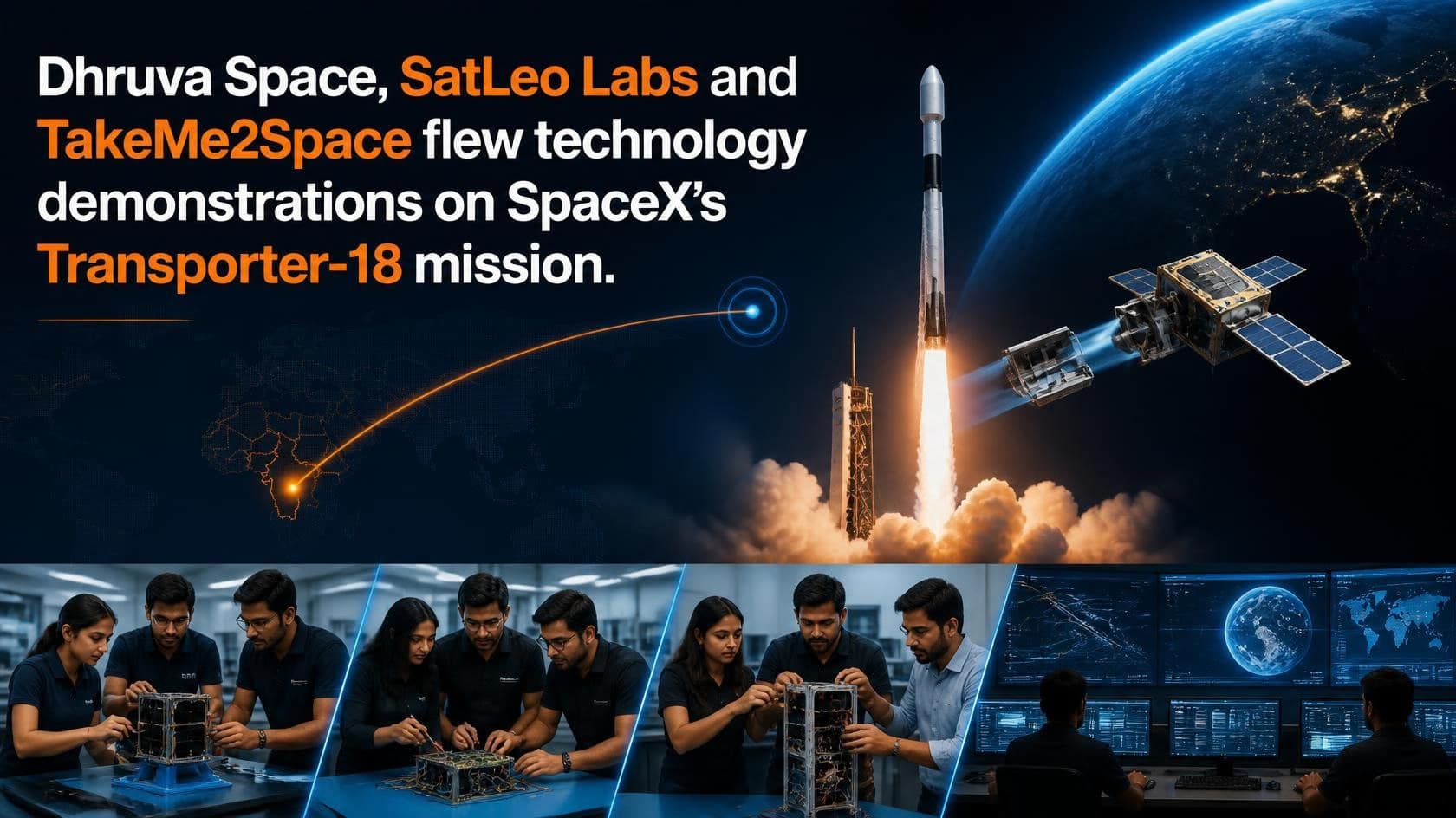
Three Indian startups put new technology into orbit this week, including a computer that runs AI on satellite images in space. They are part of a private space industry that did not exist in India a decade ago.
Bengaluru, October 3, 2026: Dhruva Space, SatLeo Labs and TakeMe2Space flew technology demonstrations on a SpaceX Falcon 9 rocket. The Transporter-18 rideshare mission lifted off from Vandenberg Space Force Base in California at 11:48 pm IST on October 1, carrying around 130 payloads, according to reports. In a rideshare, many small satellites share one rocket, which cuts launch costs for startups.
What the three startups are testing
Dhruva Space (Hyderabad) flew its LEAP-2 mission, which offers hosted payloads: customers fly experiments on a satellite platform the company provides. LEAP-2 also carries a star tracker from France’s Sodern, a sensor that helps a satellite work out its orientation. It follows Dhruva’s first commercial satellite, LEAP-1, which flew on a Falcon 9 in August 2025.
SatLeo Labs (Ahmedabad) flew TAPAS-1 on LEAP-2. The company calls it India’s first dedicated commercial thermal payload. It weighs roughly 3 kg and uses long-wave infrared sensing to measure land-surface temperature from orbit.
TakeMe2Space (Hyderabad) launched MOI-1A, which it calls India’s first orbital computing satellite. According to the company, the 14-kg satellite carries 117 trillion operations per second of computing capacity, 2 TB of storage and a nine-band multispectral imager. The idea is to run AI on images in orbit and send down only the results, not huge volumes of raw pictures. The company says it has signed 23 customers and cites uses such as agricultural monitoring, mining and supply-chain intelligence. MOI-1A also carries an imaging system from EON Space Labs, which is why some reports list EON as the third startup.
How India got here
For decades, India’s space activity was run by the Indian Space Research Organisation (ISRO). In 2020, the government opened the sector to private companies and created IN-SPACe to authorise and support them. The 2023 Indian Space Policy then said ISRO should focus on research and development, with more private participation across the space value chain.
What the numbers show
- About 440 registered space startups (August 2026), up from one in 2014, according to a written reply in the Rajya Sabha
- 113 IN-SPACe authorisations to 52 non-government entities, 18 of them startups
- Private investment of about $618.5 million by March 2026, nearly six times earlier levels
- A space economy of about $8.4 billion, around 2% of the global total, with IN-SPACe projecting $44 billion by 2033
The businesses emerging beyond ISRO
- Launch services. Skyroot Aerospace launched India’s first private orbital rocket, Vikram-1, in July 2026, after its first private suborbital rocket in 2022. Agnikul is another launch startup.
- Satellite platforms and hosted payloads. Dhruva Space builds satellites and rents space on them to others, as LEAP-2 shows.
- Earth imaging and data. SatLeo’s thermal sensing and imaging satellites such as Pixxel’s sell data and insights, not only hardware.
- AI in orbit. TakeMe2Space aims to cut the need to download raw imagery by processing it in space.
- Tracking objects in orbit. Digantara works on space situational awareness, which matters more as more satellites launch.
- Components and testing. Startups also build parts such as propulsion and docking systems, and IN-SPACe has opened ISRO test facilities to private firms.
The challenges
- A small share of a big market. India’s roughly 2% share of the global space economy is far below its target.
- Money is concentrated. One analysis says Skyroot and Pixxel account for a large share of disclosed funding, so many of the 440 startups have limited access to capital.
- Registered is not authorised. Only 52 non-government entities hold IN-SPACe authorisations, though startups can register for other reasons.
- Launch is only the first step. The satellites must now be commissioned and show that their instruments work. Results will show whether customers will pay for in-orbit computing and thermal data.
What to watch next
- First confirmed signals and data from MOI-1A and TAPAS-1
- Further LEAP missions from Dhruva Space, and Skyroot’s next Vikram-1 launches
- TakeMe2Space’s plan for a six-satellite constellation, with two satellites booked on a Falcon 9 in late 2028
- Whether the ₹1,000 crore government venture fund for space startups reaches more companies
Stay with DWN for more updates on technology, space and Indian startups.