


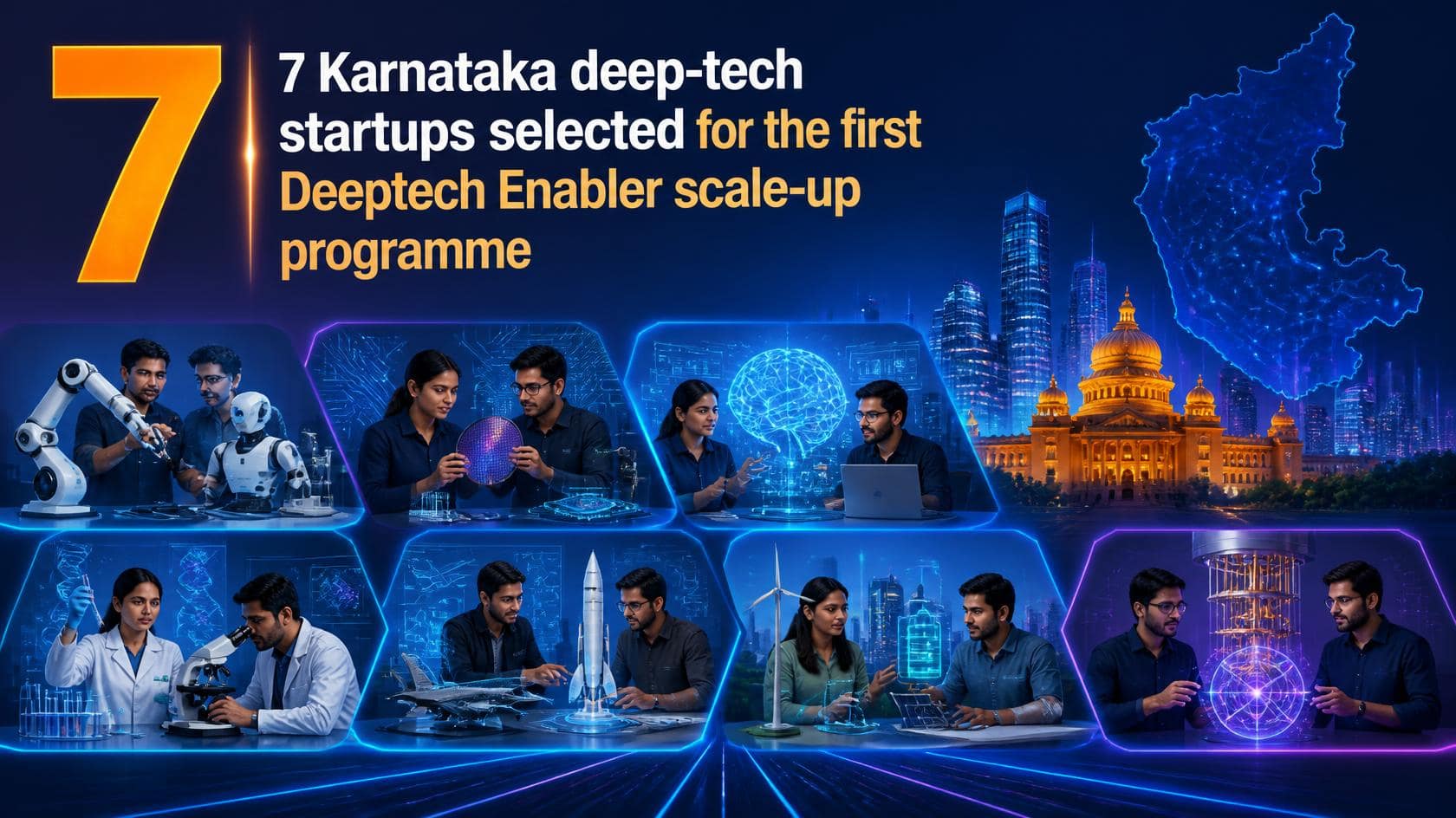
Seven deep-tech startups from Karnataka have been chosen to scale up under a new government-backed programme. From amphibious drones and space propulsion to silk-based wound care and satellite AI, here’s what these companies are building and why it matters.
Karnataka’s Innoverse Foundation has selected seven growth-stage startups as the first cohort of its Deeptech Enabler programme. The initiative is designed to support companies that have already moved beyond early technology validation and demonstrated market traction, but still need structured help to scale further.
According to the state’s IT/BT department, the selected startups will receive support in areas such as market access, capital mobilisation, policy assistance, and access to technology and scale-up infrastructure. The first cohort is expected to run through June 2027. Progress will be measured against clear outcomes including revenue growth, capital raised, anchor-customer contracts, certifications, and pathways into international markets.
The programme reflects a shift in Karnataka’s startup strategy. After years of supporting early-stage innovators, the state is now focusing on helping companies that already have working products and paying customers grow into larger, more competitive businesses.
The Seven Startups and Their Technologies
1. AquaAirX Autonomous Systems
AquaAirX is developing AI-powered amphibious drones capable of operating seamlessly in both air and underwater environments. Their platforms are designed for maritime surveillance, port security, underwater inspection, and defence applications. The ability to transition between domains without changing systems gives them a distinct advantage in complex operational settings.
2. Fibroheal Woundcare
This biotech company uses silk proteins to create advanced wound-care solutions. Their product range includes haemostatic sponges, specialised dressings, and gels aimed at treating acute, chronic, and traumatic wounds. The technology has applications in both civilian healthcare and defence medical use, where rapid and effective wound management is critical.
3. Hyspace Technologies (SkyServe)
Hyspace is building onboard AI and edge-computing solutions for satellites. Their technology allows Earth observation data to be processed in space rather than being sent entirely to the ground. This reduces latency and bandwidth requirements, making real-time insights possible for applications such as environmental monitoring, disaster response, and strategic surveillance.
4. OptM Media Solutions
OptM works across defence electronics, automotive systems, media and broadcast technology, and artificial intelligence. The company specialises in product engineering, developing embedded systems and integrated hardware-software solutions for complex industrial and defence requirements.
5. SpaceFields
An IISc-incubated startup, SpaceFields focuses on solid rocket propulsion and energetic materials for aerospace and defence. The company is developing high-performance solid propellants and advanced propulsion systems, including work on aerospike engine technology that could improve efficiency across different altitudes.
6. UNMANND Autonomy
UNMANND is building intelligent autonomous drones designed for defence logistics and counter-drone operations. Their systems emphasise edge AI, multi-agent coordination, and the ability to function in GPS-denied or electronically contested environments — conditions increasingly common in modern security scenarios.
7. Yaanendriya
Yaanendriya develops indigenous navigation controllers, high-precision inertial sensors, and advanced sensor-fusion systems. Their technology enables drones, ground robots, and other autonomous platforms to maintain accurate positioning and control even when satellite navigation signals are weak or unavailable.
Why This Selection Matters
The seven startups represent a mix of aerospace, defence, space technology, biotechnology, and advanced sensing — sectors that align closely with Karnataka’s long-term deep-tech ambitions. By supporting companies that already have market traction, the Deeptech Enabler programme aims to reduce the gap between promising innovation and commercial scale.
If successful, the initiative could help these firms strengthen their presence in domestic and global markets while contributing to the state’s broader goal of building a stronger deep-tech ecosystem. The performance of this first cohort will be closely watched as an indicator of how effectively Karnataka can convert advanced technologies into scalable businesses.