


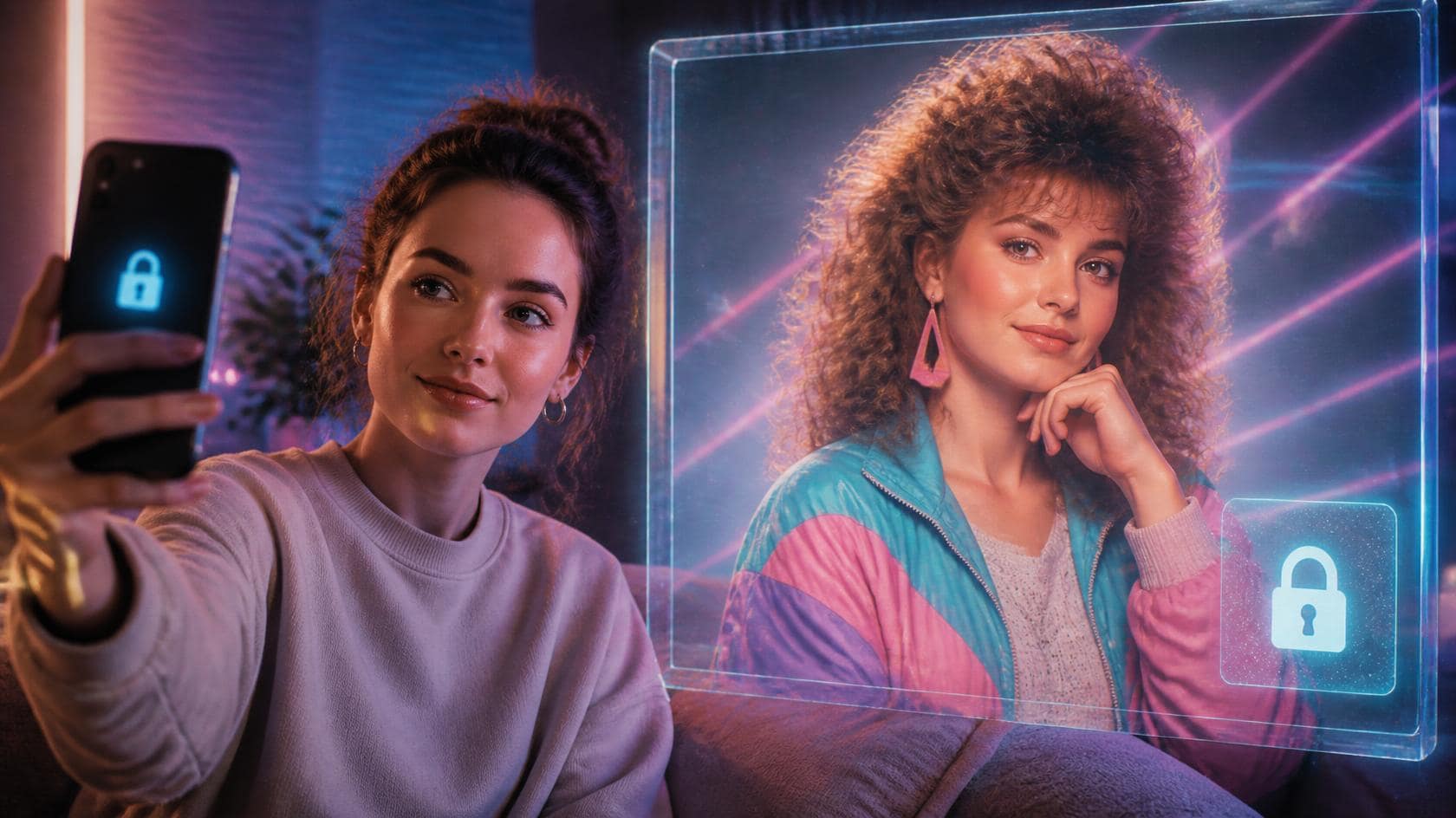
Scroll through Instagram right now and you’ll see it everywhere — friends, relatives, even people who never post selfies, suddenly sharing photos of themselves that look like they were pulled straight out of a 1980s family album. Faded colours, old sarees, box-type TVs in the background, grainy film texture. It’s not a filter. It’s AI, and it’s the biggest photo trend India has seen since the Studio Ghibli craze.
Here’s what’s actually going on — and the part most “here’s the prompt” articles skip: what happens to your photo once you upload it, and whether you should be doing this at all.
What Is the 1980s AI Photo Trend?
At its core, the trend is simple: you upload a current photo of yourself to an AI tool — mainly Google Gemini or ChatGPT — along with a written prompt describing how you want to look. The AI then generates a new image that keeps your face recognizable while changing everything around it: your hairstyle, clothing, the background, and the “texture” of the photo itself, so it looks like it was shot on film decades ago rather than on a smartphone yesterday.
The results usually include:
- Period-accurate hairstyles and retro Indian clothing — sarees, high-waisted trousers, aviator sunglasses
- Old cars, scooters, and box-type television sets in the background
- Warm, faded colours and visible film grain, mimicking analog photography
- Soft flash lighting, like an old studio portrait
This specific wave in India has largely been powered by Google’s Gemini 2.5 Flash Image tool, nicknamed “Nano Banana” by users — it reportedly generated over 500 million images and onboarded 23 million users globally within just two weeks of a related viral moment.
Why Has It Suddenly Become Popular in India?
A few things came together at once:
- Nostalgia sells, always. For a generation of Indians whose parents’ wedding albums and childhood photos are exactly this aesthetic — warm-toned, slightly faded, studio-flash portraits — seeing themselves recreated in that same style hits an emotional note that a generic filter never could.
- The tools got dramatically better. Earlier AI image tools produced faces that looked “off” or generic. The current generation of tools is specifically good at preserving a person’s actual facial identity while changing everything else — which is what makes the results feel personal rather than like a random cartoon avatar.
- It’s a low-effort, high-reward social post. No outfit to arrange, no photographer needed — just an existing photo and a copy-pasted prompt, and you get something genuinely shareable.
- Regional versions caught fire too. Beyond generic “80s photo” prompts, hyper-specific versions — like 1980s South Indian cinema-style portraits with monsoon backdrops and vintage film posters — have been spreading fast, giving the trend local flavour rather than feeling like a copy-pasted global fad.
How Are People Creating These Images?
The process people are following is fairly consistent:
- Open Gemini or ChatGPT and upload a clear, current photo of themselves
- Paste a detailed prompt describing the desired look — most viral prompts specifically instruct the AI to preserve the person’s real facial structure, skin tone, and expression rather than generating a generic face
- Specify the era-appropriate details: hairstyle, clothing, background elements, and photographic texture (film grain, soft flash, faded colour)
- Generate, review, and often regenerate a few times to get a result that looks convincing rather than obviously artificial
Dozens of websites have sprung up purely to share ready-made copy-paste prompts for this trend — which is useful, but it’s also exactly why the more important questions (what happens to your photo, and is this safe) are getting skipped by most of the coverage.
What Happens to the Photos You Upload?
This is the part worth actually slowing down for.
Policies differ by platform, and they’re not always fully transparent. When directly asked about data handling, AI chatbots have told users that companies don’t retain or use uploaded images beyond the immediate session — but other AI tools have indicated that uploaded data may be stored on company servers and potentially used to train future models unless a user actively opts out in settings.
A viral incident in India raised real questions about this. An Instagram user documented that an AI-generated image of herself included a mole on her hand that was accurate to her real body — but wasn’t visible anywhere in the photo she actually uploaded. She called the experience “scary and creepy,” and it sparked a wider conversation about whether these tools are drawing on more personal data than users realize, whether from other photos, metadata, or broader digital footprints.
Security experts have flagged three main concerns:
- Storage and retention — some platforms keep uploaded images for training or analysis; others discard them after processing. Reading the platform’s actual privacy policy is the only reliable way to know which applies.
- Data breaches and hacking risk — one privacy expert specifically advised treating AI chatbots like cloud storage services such as Google Photos, but with the added risk that company staff may review sampled user conversations and images even after a user believes they’ve deleted them.
- Deepfake and misuse risk — because these tools can convincingly alter a real face, experts warn that uploaded facial images could theoretically be repurposed for face-swapping scams or deepfakes down the line, particularly on lesser-known or unverified AI tools.
Google has said it uses SynthID, an invisible watermark embedded in AI-generated images to mark them as artificial — but this isn’t something an ordinary viewer can easily verify by looking at a photo, which means a convincing fake could still circulate without anyone flagging it as AI-made.
Is It Safe to Upload Your Personal Photographs?
The honest answer: for an ordinary, everyday selfie, the risk is generally low — but “everyday selfie” is doing a lot of work in that sentence.
Security researchers frame it as a simple test: if this exact photo landed in a stranger’s inbox tomorrow, would it cost you money, safety, or someone’s trust? If yes, don’t upload it to a public AI tool.
Specifically avoid uploading:
- Photos with visible personal documents, ID cards, or financial information in frame
- Screenshots containing passwords, OTPs, or addresses
- Clear photos of other people who haven’t consented to being uploaded
- Anything you wouldn’t be comfortable existing on a company server indefinitely
A few practical steps that reduce your risk without giving up the trend entirely:
- Turn off model training on your data, where the option exists — both ChatGPT and Gemini have settings that let you opt out of your uploads being used to train future models
- Use a temporary or incognito-style chat session if the platform offers one — these typically aren’t saved to your history or used for training
- Check the platform’s actual privacy policy, not just assume good intent, especially before trying lesser-known or unverified AI apps riding on the trend’s popularity
- Think twice before uploading photos of children or other people without their knowledge
The Bottom Line
The 1980s AI photo trend is genuinely fun, and for most people posting a casual, already-public-style selfie, it’s low-risk. But the same technology that can lovingly recreate your mother’s wedding-album aesthetic is built on data practices that most users never read before clicking “upload.” Enjoy the nostalgia — just don’t skip the privacy settings on your way there.
This article is for general informational purposes. Data handling practices vary by platform and can change over time — always check the current privacy policy of the specific AI tool you’re using before uploading personal photographs.