


Parliament’s 2026 Monsoon Session ended this week having passed 12 bills in three-and-a-half weeks — but nine of those went through without a single MP other than the piloting minister saying a word. Prime Minister Narendra Modi and Home Minister Amit Shah were largely absent from the floor through much of the session, even as the Opposition repeatedly demanded their presence to answer questions on the NEET-UG paper leak and the student protests at Jantar Mantar that followed. This raises a question bigger than one session: can Parliament legally pass a Bill without the PM or Home Minister present, and does that satisfy the constitutional promise of accountable government?
What Happened This Session
The session opened on July 20 under pressure — the Opposition, fresh off setbacks in the West Bengal and Assam Assembly elections, rallied around the NEET-UG paper leak and the students’ protests that followed. The pressure escalated until Education Minister Dharmendra Pradhan resigned on July 25, citing the government’s response — a CBI probe, exam cancellation, and re-test — in his resignation letter.
Against that backdrop, the government’s own legislative agenda largely stalled. The Delimitation Bill, 2026 (which would expand the Lok Sabha from 543 to 850 seats) was held back in the face of Opposition resistance, and the Foreign Contribution (Regulation) Amendment Bill, 2026 was referred to a Joint Parliamentary Committee rather than pushed through.
Parliamentary Affairs Minister Kiren Rijiju confirmed that of the 12 bills passed, 11 went through the Lok Sabha without discussion — only one received a proper debate. Congress MP Gaurav Gogoi said he had rarely seen a government appear as “unsettled,” pointing directly to the PM’s and HM’s absence. On the session’s final day, Rahul Gandhi rejected a last-minute offer from Amit Shah to extend the session for debate, accusing him of having stayed away for most of the session.
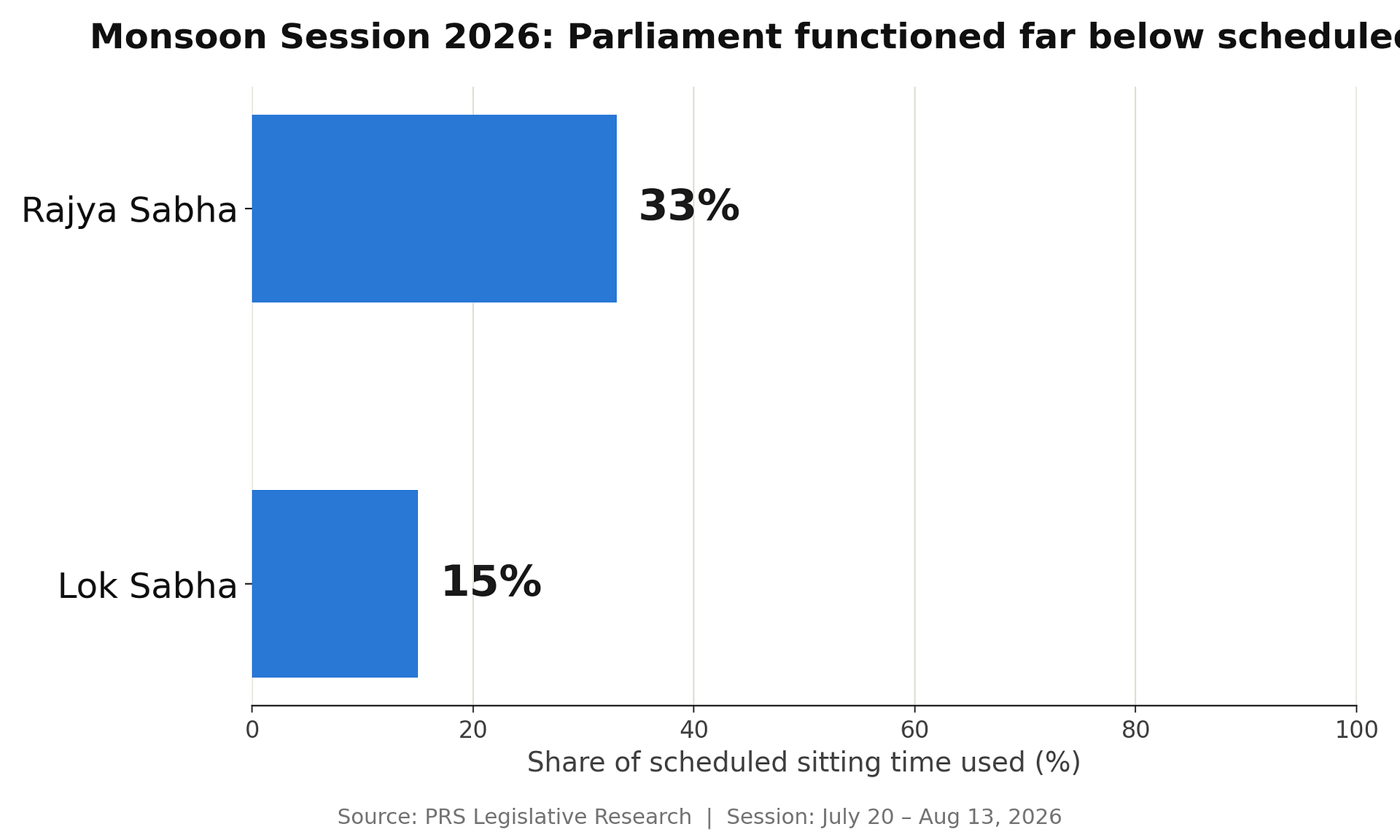
The numbers, from PRS Legislative Research:
- Lok Sabha functioned for just 15 percent of scheduled time; Rajya Sabha for 33 percent.
- Question Hour — the mechanism built to hold ministers individually accountable — ran for only nine minutes (1 percent) in the Lok Sabha, and about two hours (12 percent) in the Rajya Sabha.
- Of 380 questions listed for oral answer in the Lok Sabha, only two were actually answered; the Rajya Sabha managed 16 of 285.
Is It Legal to Pass a Bill Without the PM or HM Present?
Yes. There’s no constitutional or procedural requirement that the PM or Home Minister be physically present for a Bill to pass. Any authorised Union Minister can pilot government business, and what matters for validity is that the Bill follows prescribed procedure and secures the House’s approval. Absence alone doesn’t make a Bill invalid.
Under Article 75(3), the Council of Ministers is collectively responsible to the Lok Sabha — that’s the actual accountability mechanism, not any one minister’s personal attendance. So a Home Minister skipping a specific debate isn’t, by itself, a constitutional breach.
The real question is different: did the government — through whichever minister — actually answer the substantive questions MPs raised? Why is this Bill necessary? What problem does it solve? What objections were raised? This session, that mostly didn’t happen either — nine bills passed with no debate at all, and Question Hour ran at 1 percent capacity. That’s the legitimate concern: not illegality, but whether Parliament got a meaningful chance to scrutinise what it was passing.
What Passed — And What Didn’t
Bills passed (12 total):
- Public Examinations (Prevention of Unfair Means) Amendment Bill — the direct response to NEET-UG; mandates fast-track courts, investigations within two months, trials within three. Received presidential assent.
- Registration of Births and Deaths (Amendment) Bill — tightens delayed registration.
- MSME Amendment Bill — national digital registration platform, better finance access.
- Bankers’ Books Evidence (Amendment) Bill — covers electronic/cloud banking records.
- Tribunals Reforms Bill — creates a National Tribunals Commission.
- Kerala (Alteration of Name) Bill — renames the state “Keralam” constitutionally.
- National Co-operative Development Corporation (Amendment) Bill.
- Mining sector amendment Bill. 9-10. Two ordinance-replacement Bills — on Supreme Court judge numbers and income tax.
(The remaining two of the twelve were referenced only in general terms in official briefings.)
Shelved or deferred:
- Delimitation Bill, 2026 — held back amid Opposition resistance.
- FCRA Amendment Bill, 2026 — sent to a 31-member Joint Parliamentary Committee instead of being passed.
Of the 12 that passed, 11 saw no Lok Sabha discussion at all; in the Rajya Sabha, one bill was fully debated, and even then the principal Opposition party walked out.
Government vs. Opposition
Rijiju blamed the Opposition for choosing disruption over debate despite the government’s willingness to discuss; Jairam Ramesh called the session a “washout,” comparing it to the disrupted 2015 session. Both claims likely hold some truth — but the numbers don’t support any claim that this was a normal, functioning session by historical standards.
The Bottom Line
A Bill passed without the PM or Home Minister on the floor isn’t, by itself, illegitimate — Parliament’s rules allow any authorised minister to carry government business, and collective ministerial responsibility is what the Constitution actually relies on. But legality is a low bar. This session’s own numbers — 11 of 12 bills passed without discussion, Question Hour at 1 percent, only 2 of 380 questions answered orally — show the form of parliamentary process was followed while its substance was largely absent. That’s the sharper question this session raises: not whether the PM or HM broke a rule by staying away, but whether Parliament, as an institution, got the chance to do the job the Constitution assigns it.
Data: PRS Legislative Research. Statements: Kiren Rijiju, Gaurav Gogoi, Jairam Ramesh, Rahul Gandhi.